How to Create a Crypto Token in 2027: A Complete Guide

Creating a crypto token in 2027 is no longer simply a matter of writing a smart contract and choosing a name and ticker. Modern token projects often connect blockchain infrastructure with payments, DeFi, gaming, governance, real-world assets, community ecosystems, or fundraising.
The technical barrier has also changed. Established token standards, reusable smart contract libraries, development frameworks, wallets, decentralized exchanges, and blockchain infrastructure can simplify token creation. Ethereum's ERC-20 standard, for example, provides a common interface that allows fungible tokens to interact with wallets and decentralized applications.
At the same time, creating a token that works technically is different from building a token that has a useful role in a real ecosystem. Founders need to define the token's purpose, choose the appropriate blockchain, design supply and distribution mechanics, develop and audit the contracts, prepare integrations, and plan how the token will operate after launch.
This guide explains the major steps involved in creating a crypto token in 2027 and the decisions businesses should make before deployment.
Start With the Token's Purpose
The first step is not choosing a blockchain. It is defining why the token should exist.
A token can represent different forms of utility within a digital ecosystem. It may provide access to services, support payments, reward users, facilitate governance, represent an asset, or coordinate activity within a decentralized application.
Ethereum's documentation notes that tokens can represent assets ranging from reputation points and in-game assets to financial assets and fiat currencies.
This makes the token's purpose the foundation of the entire development process.
For example, a DeFi protocol may need a governance or utility token. A blockchain game may use a fungible token for its economy. A real-world asset platform may use tokenized assets with a substantially different structure from a conventional utility token.
If the token has no meaningful role in the product, adding blockchain functionality may create complexity without solving a genuine business problem.
Choose the Right Blockchain
Once the use case is clear, the next decision is selecting the network.
Ethereum remains an important option because of its mature smart contract ecosystem and established token standards. However, businesses in 2027 can evaluate Ethereum alongside Layer 2 networks and other smart contract platforms based on transaction costs, speed, liquidity, developer infrastructure, user activity, and ecosystem compatibility.
Ethereum's token standards are designed to improve interoperability between smart contracts and applications.
The choice should therefore depend on the token's expected environment.
A project requiring deep Ethereum ecosystem integration may choose Ethereum or an Ethereum-compatible network. A high-volume application may prioritize transaction economics. A multi-chain business may design its architecture around several networks from the beginning.
Cross-chain deployment also requires additional planning. The BIS has highlighted that tokens issued across separate blockchains can remain siloed without appropriate interoperability mechanisms.
Choosing a chain is therefore both a technical and commercial decision.
Decide Between a Standard and Custom Token
Most projects do not need to invent an entirely new token standard.
For fungible assets, ERC-20 provides an established interface covering functions such as transfers, balances, allowances, approvals, and total supply.
Established libraries such as OpenZeppelin also provide reusable implementations and extensions for ERC-20 tokens. Current OpenZeppelin Contracts documentation includes extensions for burning, capped supply, pausing, voting, permits, cross-chain functionality, and other use cases.
Using established components can reduce unnecessary development work and make integrations easier.
A custom token architecture may make sense when the project has requirements that existing standards cannot adequately support. However, custom functionality increases development, testing, and security requirements.
The goal should be to use the simplest architecture that supports the actual product.
Design Tokenomics Before Coding
Tokenomics determines how the token enters, moves through, and remains within the ecosystem.
Important decisions include:
- Total token supply
- Initial circulating supply
- Token allocation
- Public and private distribution
- Team and advisor allocations
- Treasury reserves
- Ecosystem incentives
- Liquidity allocation
- Vesting schedules
- Minting and burning
- Token release mechanisms
A project might create 1 billion tokens but initially release only 100 million. The remaining tokens could be distributed gradually through team vesting, ecosystem programs, treasury releases, or other predefined mechanisms.
This distinction between total supply and circulating supply can significantly affect how the token behaves after launch.
Token supply mechanisms are not defined by the ERC-20 standard itself. OpenZeppelin notes that developers need to implement their own supply mechanism, whether that involves a fixed supply or controlled minting.
Therefore, tokenomics needs to be finalized before the smart contract architecture is locked.
Build the Smart Contract
After tokenomics comes smart contract development.
For an ERC-20 token, developers typically define the token name, symbol, decimals, supply mechanism, transfer functionality, and administrative permissions.
The standard provides the core interface, but the business decides how the token should actually operate.
For example, a fixed-supply token may mint its entire supply during deployment. Another project may require controlled minting through an authorized contract. A governance token may incorporate voting functionality. A token used in a rewards system may require additional distribution contracts.
OpenZeppelin's ERC-20 implementation is intentionally modular. Its documentation states that the base implementation does not define how supply is created, allowing developers to add an appropriate supply mechanism.
This makes architecture decisions particularly important.
Add the Features the Product Actually Needs
Crypto tokens can include significantly more functionality than basic transfers.
Depending on the use case, a project may require:
Minting: Creates additional tokens under controlled conditions.
Burning: Permanently removes tokens from circulation.
Capped supply: Establishes a maximum amount that can be minted.
Pausable transfers: Provides an emergency mechanism for temporarily restricting transfers.
Vesting: Releases allocated tokens according to a predefined schedule.
Permit approvals: Allows certain approvals through signed messages instead of a separate approval transaction.
Governance: Connects token ownership with voting mechanisms.
OpenZeppelin currently provides implementations for many of these extensions.
However, additional functionality should have a clear reason. Every privileged function creates another area that requires testing, access control, documentation, and security review.
Test the Token Before Mainnet Deployment
Smart contract testing should happen before real assets are introduced.
Developers can test standard transfers, approvals, allowances, supply controls, access permissions, edge cases, and interactions with other contracts.
The testing environment should reflect the token's intended use.
For example, a token connected to an ICO platform needs testing around contributions, allocations, claims, refunds, and wallet eligibility. A staking token requires testing around deposits, withdrawals, rewards, and accounting.
Testing should also cover unexpected behavior.
What happens if an unauthorized wallet attempts to mint tokens? What happens when a transfer exceeds an account balance? What happens when a vesting contract reaches its release date? How does the system behave if an external integration fails?
These scenarios can expose issues that basic transfer testing may miss.
Conduct a Security Review
Security is one of the most important stages of token development.
A vulnerability in a token contract can affect balances, supply, administrative permissions, or connected applications.
The security process can include automated testing, manual code review, access-control analysis, vulnerability assessment, and an independent smart contract audit.
Administrative permissions deserve particular attention. If an administrator can mint unlimited tokens, pause transfers, or change important settings, the project needs clearly defined controls around those privileges.
Multisignature wallets, role-based access control, timelocks, and governance mechanisms can be considered depending on the architecture.
Security should therefore be designed into the token rather than treated as a final checklist before launch.
Deploy the Token
Once development and security testing are complete, the token can be deployed to the selected blockchain.
Deployment involves sending the compiled smart contract to the network and paying the applicable transaction fees.
The deployment process also requires careful control of constructor parameters and administrative addresses. A mistake during deployment can be difficult or impossible to reverse if the contract is immutable.
The team should therefore verify:
- Contract configuration
- Token name and symbol
- Initial supply
- Decimals
- Administrative addresses
- Minting permissions
- Ownership configuration
- Vesting addresses
- Treasury addresses
- Network selection
After deployment, the contract should be verified through a compatible block explorer where applicable.
Connect Wallets, Applications, and Liquidity
A token becomes more useful when users can interact with it through familiar infrastructure.
Depending on the project, this can include wallet integration, decentralized exchanges, staking applications, governance platforms, payment systems, dashboards, and portfolio interfaces.
The development team may also need to build a token management dashboard that displays balances, transactions, vesting schedules, staking positions, or other project-specific information.
Liquidity planning is another important component.
A token intended for open-market trading needs a clear approach to liquidity provision and trading infrastructure. The technical implementation can involve decentralized exchange pools, market-making arrangements, or other liquidity mechanisms depending on the project's model.
Launching the token without considering how users will acquire, hold, transfer, and use it can create a disconnect between the token and the product.
Consider Compliance Before Launch
Token development also involves legal and regulatory considerations.
The regulatory treatment of a token can depend on its characteristics, distribution method, investor expectations, jurisdiction, and intended use.
Projects should therefore obtain appropriate legal advice before launching a token, particularly when the token is connected to fundraising, investment rights, revenue claims, asset ownership, or financial services.
This becomes increasingly important for projects operating across multiple countries.
Technical development and legal structuring should not happen independently. The token's functionality, distribution model, marketing claims, investor eligibility, and transfer restrictions may all need to reflect the applicable legal framework.
Plan the Token Launch
Creating the token is only part of the launch process.
A commercial token launch may require a coordinated strategy covering community building, website development, documentation, token distribution, liquidity, exchange preparation, investor communication, and post-launch support.
The launch plan should explain how users discover the token, acquire it, understand its utility, and begin using it.
For fundraising projects, the token sale architecture may also require contribution limits, investor onboarding, eligibility checks, allocation logic, vesting, and claim functionality.
A strong launch connects these components rather than treating token deployment as the final milestone.
Manage the Token After Launch
Post-launch management can be as important as development.
The team needs to monitor contract activity, circulating supply, liquidity, user adoption, treasury movements, security alerts, and ecosystem activity.
If the token includes vesting, future unlocks should be communicated clearly. If the project uses treasury reserves, movements should follow established governance or authorization procedures.
For multi-chain tokens, the team must also monitor cross-chain infrastructure and supply consistency.
The BIS has highlighted interoperability challenges when similar token assets exist across separate blockchain networks.
Long-term token management should therefore be included in the architecture from the beginning.
How Much Does It Cost to Create a Crypto Token in 2027?
There is no universal cost for creating a crypto token.
A basic token with a fixed supply and standard transfers requires considerably less development than a complete ecosystem involving staking, governance, vesting, an ICO platform, custom dashboards, exchange integrations, multi-chain deployment, and independent audits.
The main cost factors include:
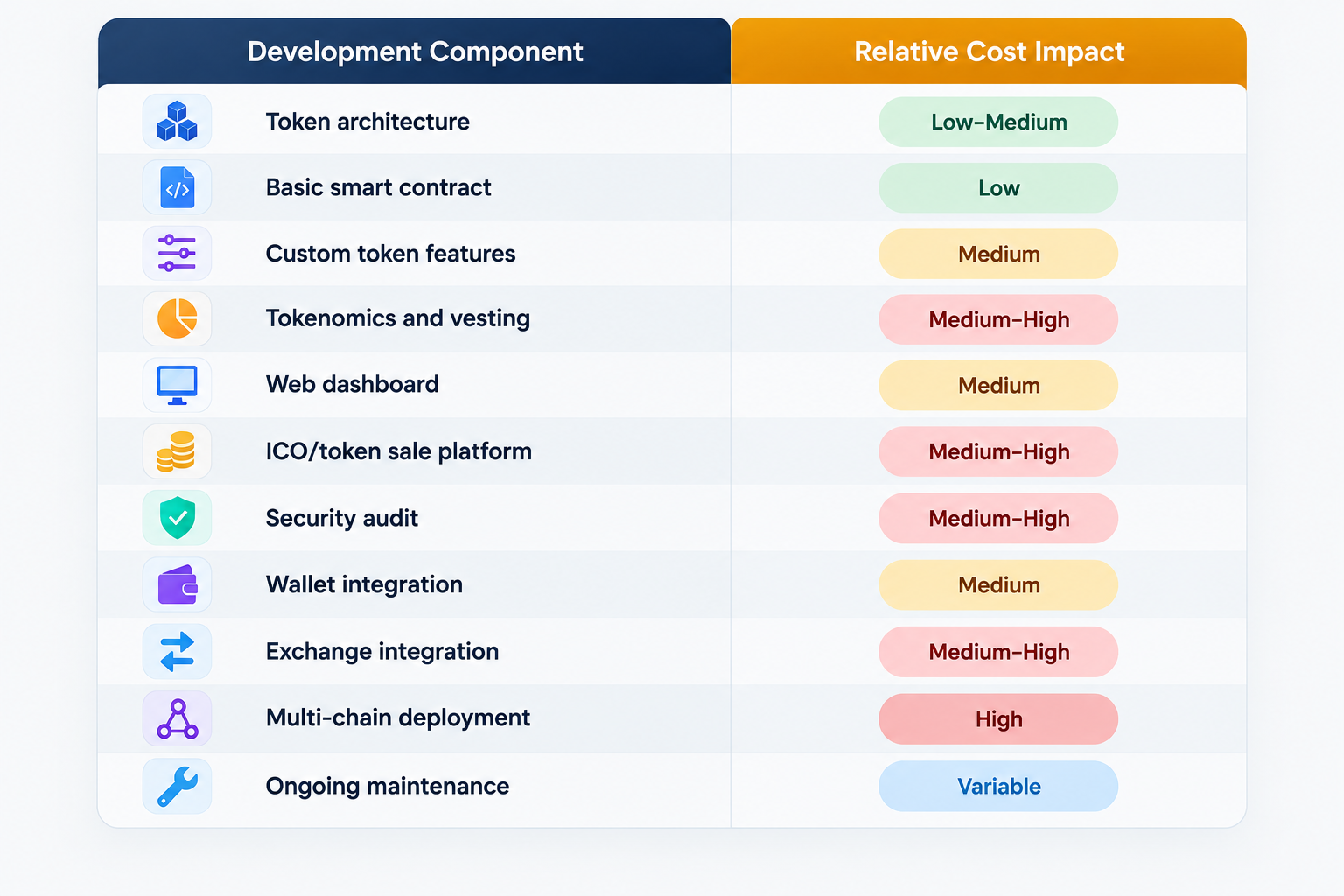
Network fees are separate from development costs and vary according to the blockchain and network conditions.
For this reason, businesses should define their complete requirements before requesting a token development estimate.
Common Mistakes to Avoid
Some token projects focus heavily on the technical contract while overlooking the surrounding ecosystem.
Common problems include creating a token without a genuine use case, choosing a blockchain without considering users and liquidity, designing unrealistic tokenomics, releasing too much supply at TGE, giving excessive administrative control to one wallet, skipping independent security review, and launching without a clear post-TGE plan.
Another common mistake is treating token creation as the entire product.
A token can provide the economic layer of a Web3 platform, but it does not replace the platform itself. If users have no reason to interact with the underlying product, token incentives alone may not create durable demand.
Building a Crypto Token for 2027
Creating a crypto token in 2027 requires a combination of product strategy, tokenomics, blockchain engineering, security, compliance planning, and launch infrastructure.
The technical process can begin with selecting an established token standard and blockchain. From there, teams can define supply mechanics, develop the smart contract, test the architecture, conduct security reviews, deploy the token, integrate wallets and applications, and prepare the ecosystem for launch.
The most important decision is not simply how to create the token. It is how the token will function after it has been created.
A well-designed token connects its technical architecture with a real product, clear utility, transparent distribution, appropriate security controls, and a practical long-term ecosystem strategy. Blockchain App Factory helps businesses approach crypto token development as a complete product infrastructure project, covering token architecture, smart contracts, tokenomics, security, deployment, and supporting Web3 integrations.
For businesses entering the token economy in 2027, that broader approach can provide a stronger foundation than treating token creation as a standalone smart contract deployment.