What Should You Ask a Software Development Agency Before Starting a Project?
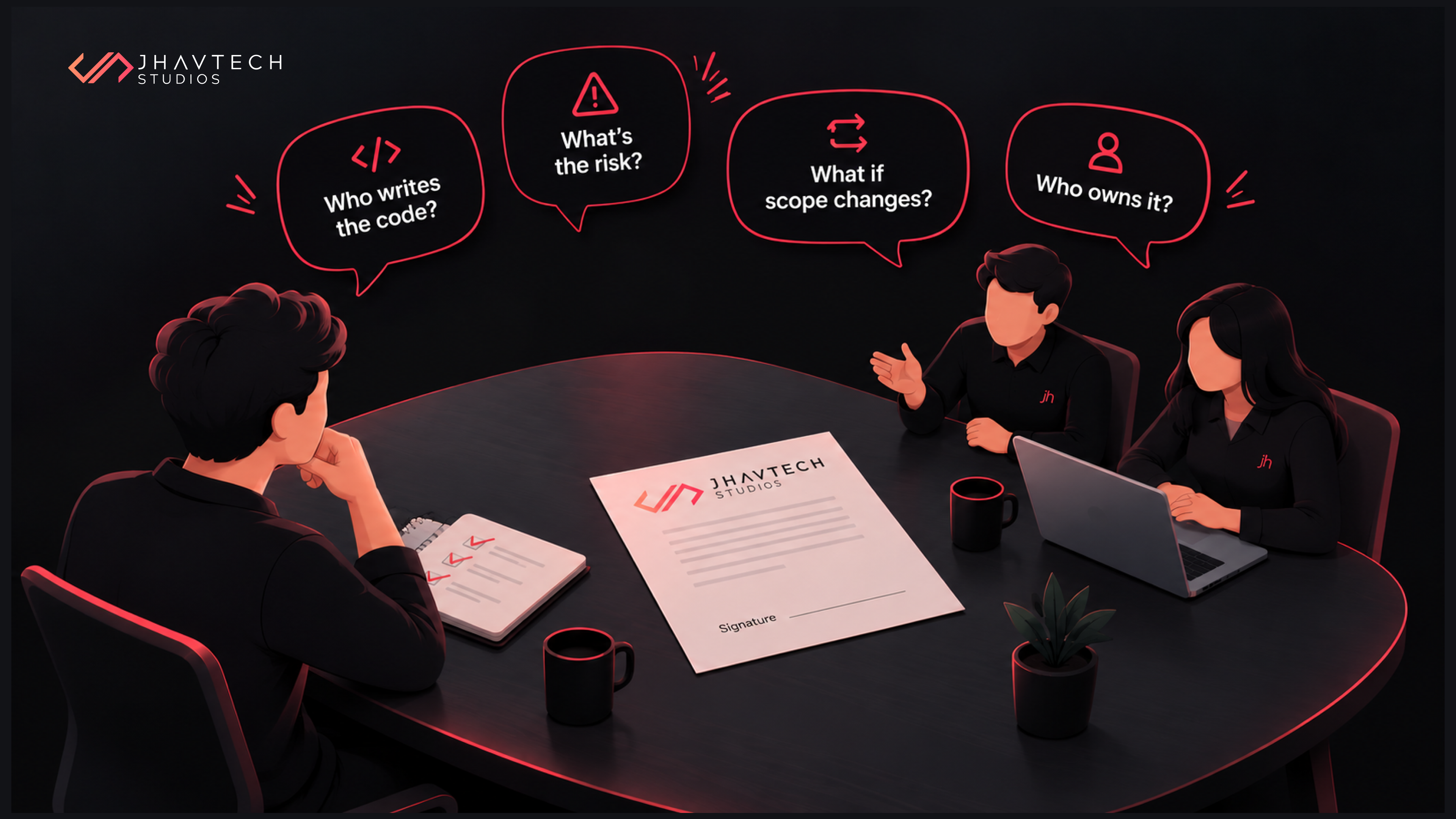
Ask a software development agency three things before anything else: who exactly will write your code, what happens the first time you change your mind, and what you own at the end. Price and timeline will dominate your first meeting if you let them, and they are the two numbers any agency has the least ability to guarantee. The questions that predict whether a build goes well are duller and far more useful.
This is the short version of how to hire a software development agency without regretting it six months later: the questions worth asking before you sign, what a good answer sounds like, and the warning signs that should make you slow down.
Quick checklist: 10 questions to ask before you sign
Why this tech stack for my product specifically?
What's the riskiest part of this build and why?
Who is writing the code, and will they still be here in six months?
Can you show me something you built that's still running three years later?
What do the first four weeks look like, day by day?
When will I first see something I can click on?
Who is my project manager, and what else are they running?
How do I find out you're running late?
What's your change process when I ask for something new?
Who owns the code, the designs, and the accounts?
The rest of this article explains what each question is really testing.
Why the questions matter more than the quote
Software projects have a long and well documented habit of blowing out. In his 2023 book How Big Things Get Done, Oxford professor Bent Flyvbjerg drew on a database of more than 16,000 projects and found that only 8.5 per cent hit both their cost and schedule targets. Add the test of whether the project delivered the benefits it promised and the figure drops to half of one per cent.
That's megaprojects, not your booking app. But the pattern holds at small scale, and the causes are the same: optimistic planning, vague scope, and nobody asking hard questions early.
McKinsey's study with the University of Oxford, published in 2012 and still one of the most cited pieces of research on the subject, looked at 5,400 large IT projects and found they ran 45 per cent over budget and 7 per cent over schedule on average, while delivering 56 per cent less value than predicted. Software was the worst performing category in the set.
Here's the part founders tend to miss. Almost none of that is caused by bad coding. It's caused by decisions made in the first few weeks, usually in rooms where nobody wanted to seem difficult.
Questions that test technical expertise (without needing you to be technical)
You don't need to understand the tech stack (the set of programming languages, frameworks and services your product is built on) to work out whether an agency knows what it's doing. You just need to ask questions where a vague answer is obvious.
"Why that tech stack for my product specifically?" A good answer references your situation: your users, your budget, where you want to be in two years. A weak answer describes what the team happens to like. If every project they've ever done uses the same tools, that's worth noting. It isn't automatically bad but ask what kind of project would make them choose differently.
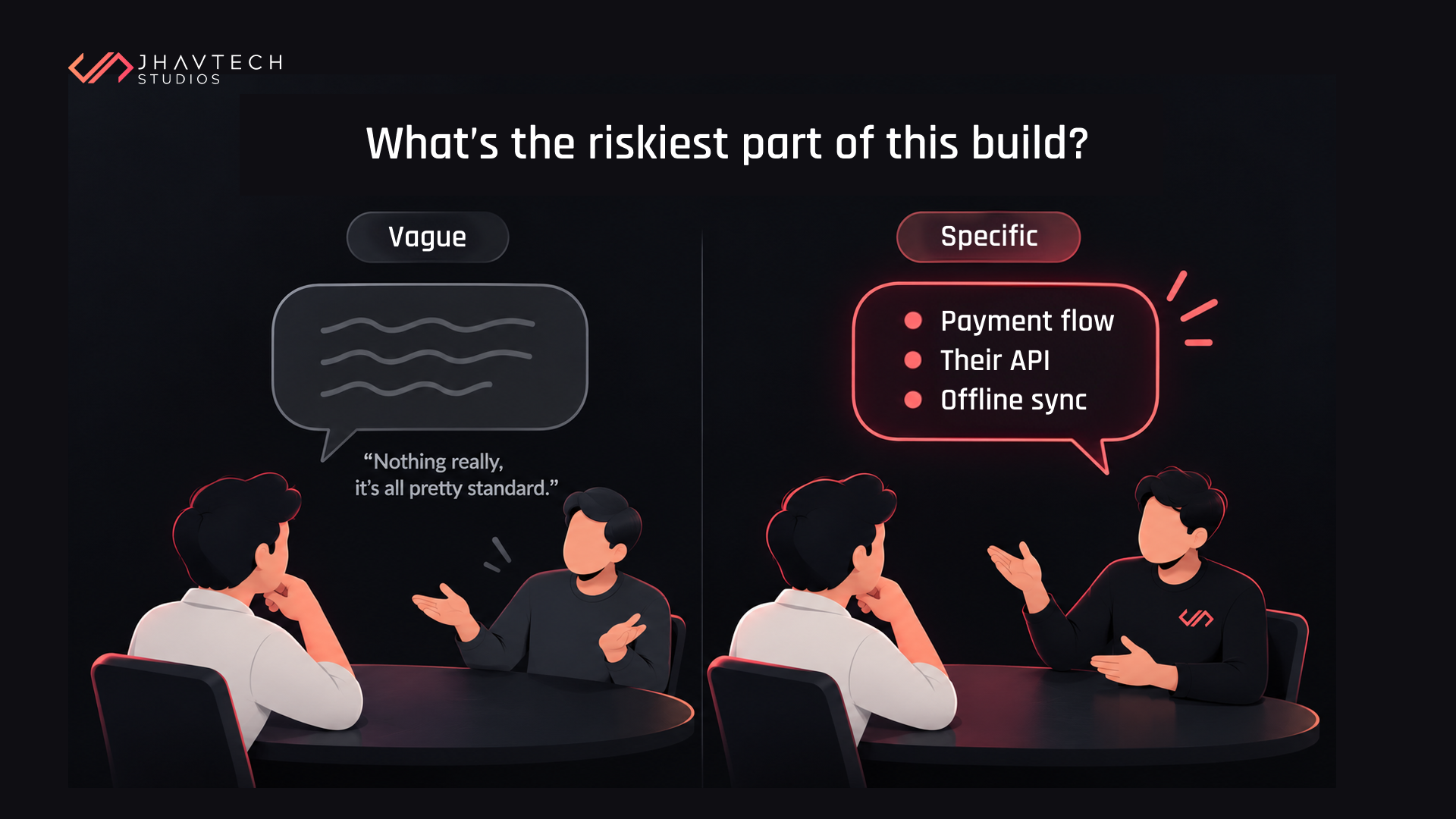
"What's the riskiest part of this build and why?" This is the single best question on the list. Anyone with real technical expertise will answer immediately, because they've already thought about it. Payment flows, an integration with a system you don't control, offline sync, anything involving another company's API. If the answer is "nothing really, it's all pretty standard", they either haven't read your brief properly or they're telling you what you want to hear.
"Show me something you built that's still running three years later." Launch screenshots are easy. Software that survived three years of real users, OS updates and feature changes is a different claim. If you're commissioning mobile app development, ask specifically how they've handled Apple and Google's annual platform changes for past clients, because that work never stops.
"Who's writing the code, and will they still be on my project in six months?" Ask for names and roles. Some agencies pitch with their best people and then hand the build to juniors, and asking the question directly tends to bring that out.
Questions about project management and the delivery process
This is where most builds quietly go wrong, and it's the part founders feel least qualified to interrogate.
Start with: "Walk me through what the first four weeks look like, day by day." A team with a real delivery process can do this without hesitating. Discovery, wireframes, a technical plan, a first working slice of the product. A team without one will talk in phases and percentages.
Then: "When will I first see something I can click on?" If the answer is more than four or five weeks away, ask why. Long stretches with nothing to look at are where misunderstandings compound. You want to be correcting course in week three, not month four.
Ask "Who is my project manager, and what else are they running?" Project management is not administrative overhead on a software build, it's the thing that keeps scope, budget and your expectations in the same place. PMI's research on project success, published in 2024, found that defining success criteria at the start and measuring against them consistently is one of the strongest predictors of a project delivering value. A PM juggling six accounts will not do that for you.
And ask "How do I find out you're running late?" The honest answer involves a number you can check yourself, like a burn-down of remaining work or a weekly demo. The answer you don't want is "we'll let you know".
Questions about communication and who you deal with day to day
Ask how often you'll speak, who you'll speak to, and in what format. Weekly is the floor. Fortnightly means you can drift a long way before anyone notices.
Ask whether you get direct access to the developers or only to an account manager. Both models can work. What doesn't work is a game of telephone where your feedback is translated twice before it reaches the person who can act on it.
If part of the team is offshore, ask about overlap hours rather than time zones. Four hours of shared working time is workable. Ninety minutes is not, and you'll feel it every time something urgent comes up on a Friday afternoon.
One more: "Who tells me when I'm asking for something expensive?" Good communication on a software build includes being told no, or at least being told what a request will cost before you commit to it. PMI's 2025 Pulse of the Profession found that only 18 per cent of project professionals demonstrated strong business acumen, which is the skill that lets someone translate a feature request into its commercial consequences. Find out whether anyone on your team has it.
What to ask a software development agency about scope, money and ownership
Scope change isn't a sign of failure. It's the normal condition of building software, and the only real question is whether your agency has a grown-up way of handling it. PMI's 2018 Pulse of the Profession found that 52 per cent of projects experienced scope creep, up from 43 per cent five years earlier, and that was before AI features started appearing on every product roadmap.
Picture adding social login to a booking app halfway through the build. Sounds small. It touches your sign-up flow, your database, your privacy policy, your testing, and the accounts of every user who already signed up the old way. A good agency will tell you that in the meeting. A weak one will say "sure, no problem" and send you an invoice you weren't expecting.
So ask: "What's your change process?" You want a written estimate before work starts, and a clear statement of what moves in the schedule to make room. Not a verbal yes.
Ask "What's explicitly not included?" The exclusions list tells you more about a proposal than the inclusions. Hosting, app store submissions, content population, training, third-party licence fees and post-launch support are the usual gaps.
Ask "Who owns the code, the designs and the accounts?" The answer should be you, in writing, including the repository, the cloud accounts, and the domain. Ask where the code lives today and whether you have access now, not on completion. Founders who skip this question are the ones who later need help to rescue a build that's already over budget and behind schedule and discover they can't even log in to their own servers.
Finally, ask what happens if you want to leave. A short, calm answer here is a very good sign.
Running a vendor evaluation that tells you something useful
Talk to three agencies. Fewer and you have no baseline. More and you'll be comparing noise.
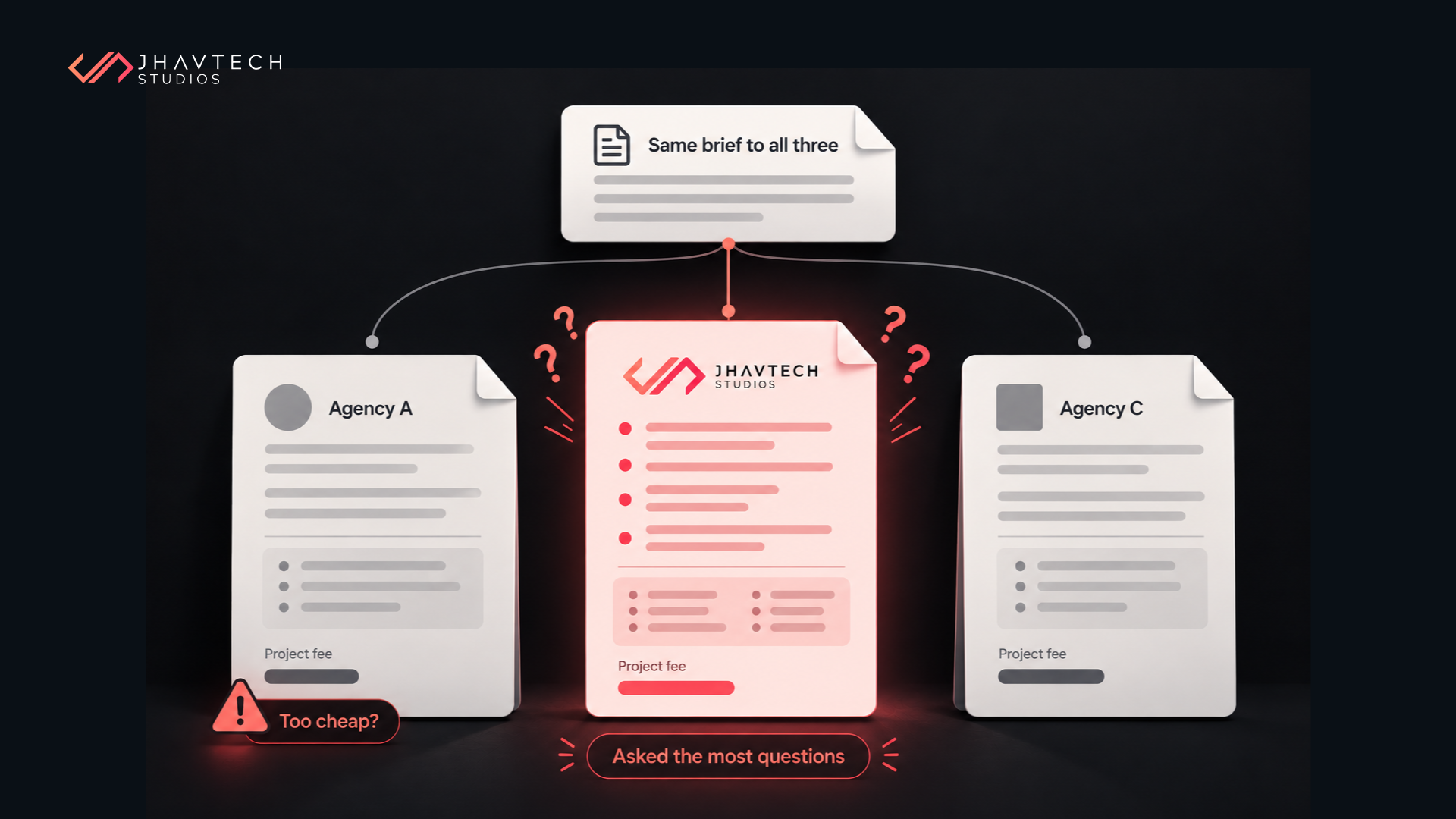
Give all three the same brief, in writing, and ask each for a fixed-scope first phase rather than a quote for the whole build. A discovery phase of two to four weeks, paid, that produces a technical plan, wireframes and a credible estimate. You'll learn more about how a team works from four weeks of real collaboration than from any amount of vendor evaluation on paper.
When the proposals come back, pay attention to the one that asked you the most questions. Agencies that push back on your brief during the sales process will push back during the build, which is exactly what you want.
Call two referees, and ask them a specific question: what went wrong, and how was it handled? Every project has a bad month. The referee's answer tells you what that month looked like.
Be wary of a proposal that's dramatically cheaper than the other two. It usually means they've scoped less than you asked for, or they're planning to make the margin back on change requests. Ask them to explain the difference. If the explanation is just "we're more efficient", keep asking.
Frequently asked questions
How much should I expect to pay for a first version?
Most serious custom builds in Australia start in the low six figures, and anything quoted well under that is usually a smaller scope than you think you're buying. Ask what the number covers and what the first twelve months of running costs look like, because the build price is rarely the whole bill.
Is fixed price or time and materials better?
Fixed price suits a tightly defined, well understood scope, and time and materials suits anything where you expect to learn as you go. Most founders are better served by a fixed-price discovery phase followed by time and materials for the build, so you're not paying a risk premium on work nobody can specify yet.
Should I hire a local agency or go offshore?
Offshore teams can be excellent, and the deciding factor is overlap hours and project management quality rather than location. The software outsourcing questions that matter most are about code ownership and who runs the delivery process on your side of the clock, so budget for that person.
What if I've already started and it's going badly?
Stop adding features and get an independent technical review of what exists before you spend another dollar. A review costs a fraction of a rebuild, and it usually finds that more of the work is salvageable than you feared.
Key takeaways
The three questions that matter most before you engage a software development agency are who writes the code, how change is handled, and what you own at the end.
Most budget blowouts trace back to decisions made in the first few weeks, not to bad code. McKinsey and the University of Oxford found large IT projects ran 45 per cent over budget on average, with software the worst performing category.
Scope change is normal. PMI found 52 per cent of projects experienced scope creep, so judge an agency on its written change process rather than on its promise to be flexible.
Ask what the riskiest part of the build is. A specific, immediate answer is the strongest signal of real technical expertise.
Test project management directly: who your PM is, what else they run, and how you'll find out you're running late.
Get code, design files and cloud accounts in your name from day one, not on completion.
Run a vendor evaluation across three agencies with the same written brief and pay for a short discovery phase before committing to a full build.
Before you sign
The founders who end up happy with their software development agency are rarely the ones who negotiated hardest on price. They're the ones who asked uncomfortable questions in the first meeting and paid attention to how the answers were delivered. Confidence is easy to fake. Specifics are not.
If you take one thing from this, take the risk question. Ask what's most likely to go wrong and watch what happens next.
When you're ready to have those conversations, our free guide 30 Things Your App Developer Won't Tell You sets out the things agencies tend to leave out of the proposal, written for founders who don't code. Worth reading before your next meeting rather than after it.