When Does Software Architecture Start Limiting Product Growth?
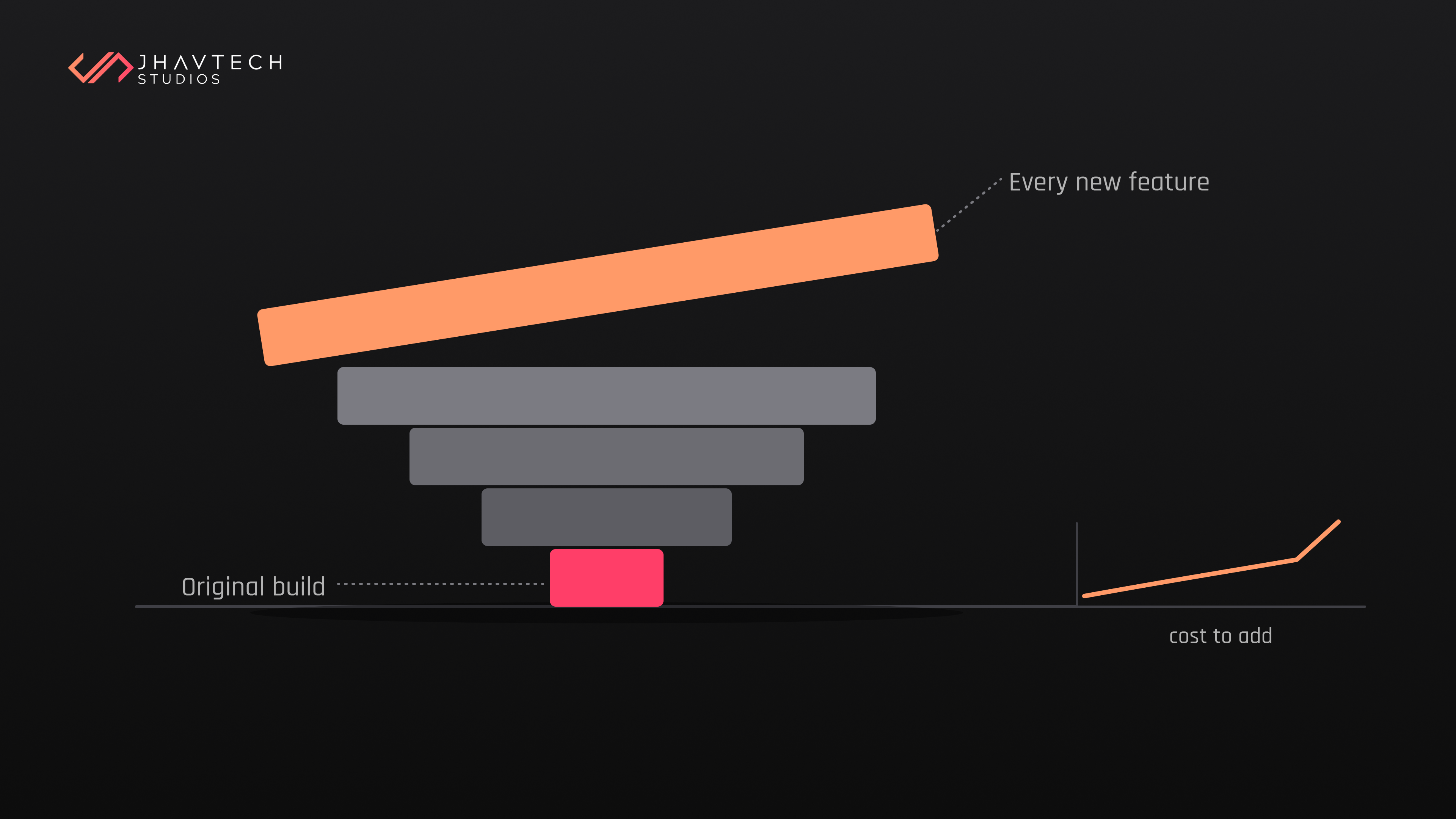
Your software architecture starts limiting growth at the point where each new feature costs more than the last one and nobody can tell you why. For most products that point arrives two or three rounds of changes after launch, well before anyone says the word "rebuild". The signs turn up on your invoices and your release dates long before they turn up in a technical report.
Below is what that looks like in practice, what the research says it costs, and what you can do about it without starting again from scratch.
What architecture means if you don't write code
Software architecture is the set of big structural decisions sitting underneath your product. How the pieces are split up. How they talk to each other. Where your data lives, and what runs where.
Some people call it system design, which means much the same thing: the shape of the whole thing rather than the detail of any one screen.
A house analogy gets you most of the way there. Paint colours and tapware are features. Where the load-bearing walls go is architecture. You can repaint a room on a Saturday. Moving a wall means engineers, permits and a month of disruption.
The other word you will hear is infrastructure, which is the servers, databases and hosting your software runs on. Architecture decides what you need from your infrastructure. Infrastructure is the bill you pay for it.
The moment it starts to bite
There is rarely a single day where things break. What happens instead is that the original design was made for a product you have since outgrown.
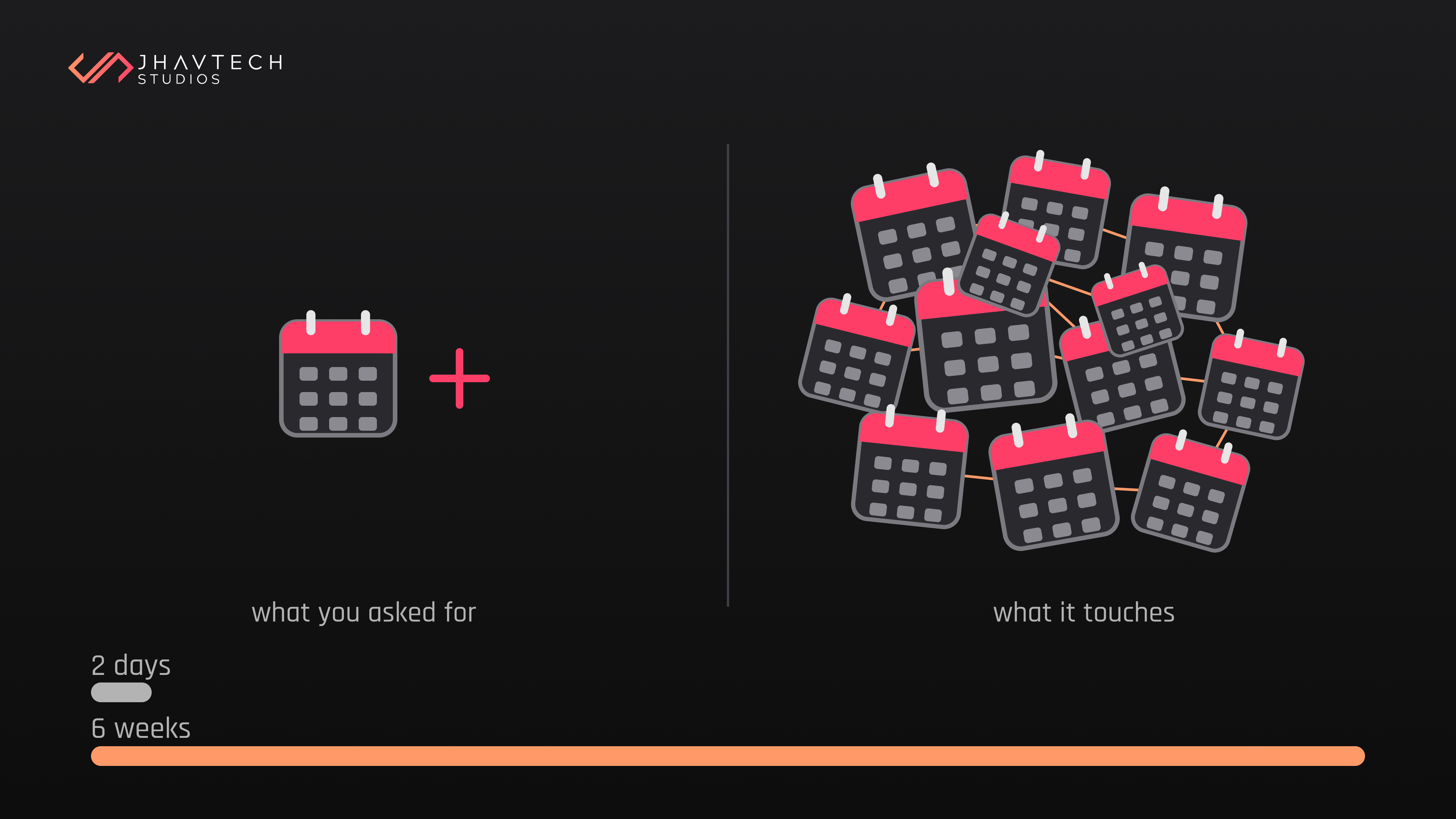
Say you built a booking app for one business with one calendar. It works beautifully. Then you sign a client with twelve locations and twelve calendars, and your developer tells you that will take six weeks. You are confused because it looks like the same screen. The problem is that the original design assumed one of everything, and that assumption is now baked into a few hundred places in the code.
Or you decide to add social login to that booking app halfway through the build, so customers can sign in with Google or Facebook. On a sensibly designed system that is a few days of work. On a system where the login logic is tangled through the booking logic, it turns into a rewrite of your user accounts.
That is the moment. Not a crash, just a quote that does not match the size of the request.
The other version of this shows up as performance. Your app was quick with 500 users and sluggish with 5,000. Nothing changed except the number of people using it. That is a scalability problem, meaning the system's ability to carry more load without a redesign, and it is almost always an architecture problem wearing a different hat.
Five signs your software architecture is the constraint
You don't need to read code to spot these. You only need to pay attention to the pattern of your conversations with your development team.
Estimates keep climbing for work that sounds simple to you, and the explanations get vaguer each time.
Fixing one thing breaks something unrelated, often in a part of the product nobody touched.
Onboarding a new developer takes months, because the only person who understands the system is the person who built it.
Your hosting bill grows faster than your user numbers.
Nobody wants to release on a Friday, and everyone treats deployment as an event rather than a routine.
Any one of these on its own might be a bad week. Three or more running for a quarter is a structural problem, and no amount of pushing the team harder will shift it.
What the slowdown really costs
This is where founders tend to underestimate the damage, because the cost shows up as slowness rather than as a line item.
According to McKinsey's 2023 research on technical debt, which is the accumulated cost of shortcuts taken in earlier builds, companies pay an extra 10 to 20 per cent on top of the cost of any new project simply to work around the problems already sitting in their systems. The same study reported that around 30 per cent of the technology leaders surveyed believed more than a fifth of their new-product budget was being diverted into fixing existing technology issues instead. That money is not building anything. It is paying interest.
The compounding effect is worse. McKinsey's analysis found organisations in the bottom fifth for technical debt severity were 40 per cent more likely to end up with modernisation programmes that stalled or were cancelled outright. The longer you leave it, the more likely the eventual fix never finishes.
There is a delivery angle too. PMI's 2026 Pulse of the Profession, drawn from more than 2,500 project professionals across 35 countries, found that roughly a third of complex projects fail to deliver the full benefits they were meant to, against about 13 per cent for projects overall. Complexity is what architecture problems feel like from the outside, and it more than doubles your odds of not getting what you paid for.
If you are hoping AI coding tools will dig you out, the evidence is mixed. Google Cloud's 2025 DORA report, based on responses from close to 5,000 technology professionals, found AI adoption lifted how much work teams shipped while delivery instability went up alongside it. Faster output on a shaky foundation gives you more broken releases, sooner.
Why this happens to sensible teams
Nobody sets out to build something that will choke in eighteen months. The early decisions were correct for the problem in front of you at the time.
When you are pre-revenue and testing an idea, the right call is usually the fastest one. Skip the multi-tenant setup. Hard-code the pricing. Put everything in one database. Those shortcuts buy you speed when speed is the whole point, and plenty of good products exist because someone made them.
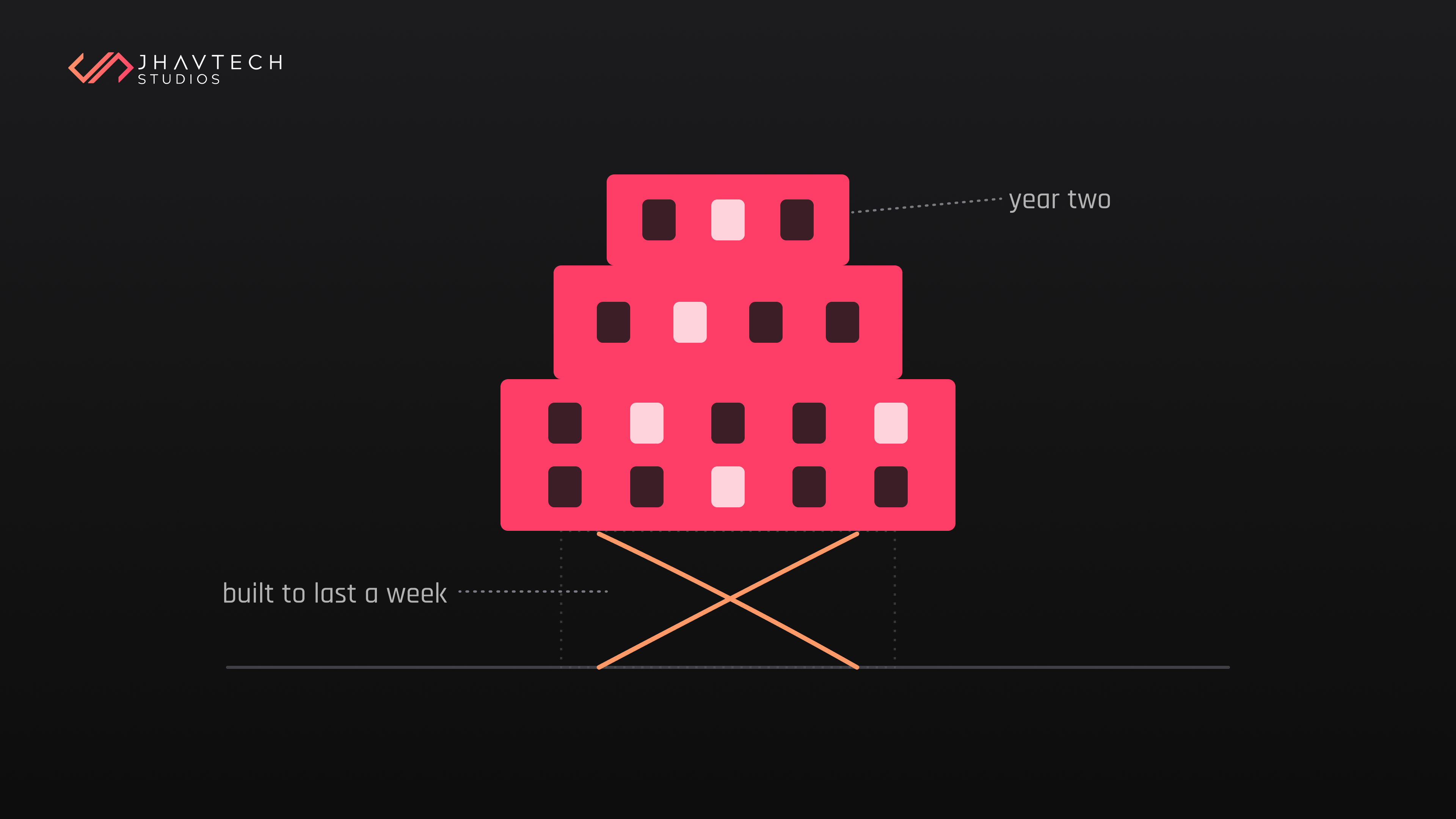
The trouble starts when the temporary build becomes the permanent one without anyone deciding that it should. You get traction, you hire, you add features on top, and the shortcut quietly becomes load-bearing. This is especially common in mobile app development, where a prototype that demos well gets pushed into the app stores and then has to carry real customers.
The missing piece is usually maintainability, meaning how easy the system is for a new developer to understand and change safely. It costs nothing to ignore in month one and a fortune to ignore in year two.
What to do when you spot it
The instinct is to rebuild. Resist that for a moment, because full rewrites are expensive, slow and risky, and you often end up with the same problems in newer syntax.
Start by getting an independent read on the code and the system design. Not from the team that built it, and not from a firm that will only quote you for a replacement. You want someone who can tell you which parts are genuinely fragile and which parts are simply unfamiliar.
Then separate the work into three buckets. What is actively costing you money every sprint. What will become a problem at ten times your current volume. What is ugly but harmless. Most teams discover the expensive problems sit in two or three specific areas, not across the whole codebase.
Fix those areas one at a time while the product keeps running. The common approach is to build the new version of a component alongside the old one, move traffic over gradually, then retire the original. It is slower than a rewrite on paper and considerably faster in practice, because you are never offline and never betting the business on a single cutover.
If things have gone further than that, and you are looking at a build that has already blown its budget and timeline, the question changes. At that point, you want to know whether the foundation can be salvaged before you spend another dollar on features. That is the work involved in getting a stalled project back on track, and it starts with an honest assessment rather than a new roadmap.
One more thing worth doing regardless: ask your team to write down the three assumptions the current design depends on. One business, one currency, one timezone, whatever they are. Knowing them means you will see the wall coming before you hit it.
Frequently asked questions
How do I know if it's an architecture problem or just a slow developer?
If the same developer was fast six months ago and is slow now on similar work, the system changed, not the person. Ask what specifically makes the current request harder than the equivalent request last year and listen to determine whether the answer points at structure or at skill.
Can I fix architecture problems without pausing feature work?
Yes, and you usually should. Most structural improvements can be done incrementally alongside your normal release schedule, though you should expect to give up roughly 20 per cent of your team's capacity for a few months.
At what stage should I invest in proper system design?
The moment you have paying customers and a second person relying on the product working, which for most startups is far earlier than they plan for. Before that, speed genuinely matters more than structure.
Is a full rebuild ever the right answer?
Occasionally, when the original technology is no longer supported, when nobody who understands the code is still available, or when the product has changed so much that almost nothing is reusable. For everything else, a staged replacement carries far less risk.
The short version
Software architecture starts limiting your growth the moment your team's answer to "can we add this?" stops being about the feature and starts being about the system. That shift is measurable, it is expensive, and it is far cheaper to address in the month you notice it than in the year you finally admit it.
If any of this sounds like your project, the fastest way to find out where you stand is to have someone look at the code. Grab The 48 Hour Code Audit and you will get a clear read on what you are working with, before your next quote lands.