Hardware-Level Security: IPMI/iDRAC Isolation, TPM 2.0, and BIOS Hardening
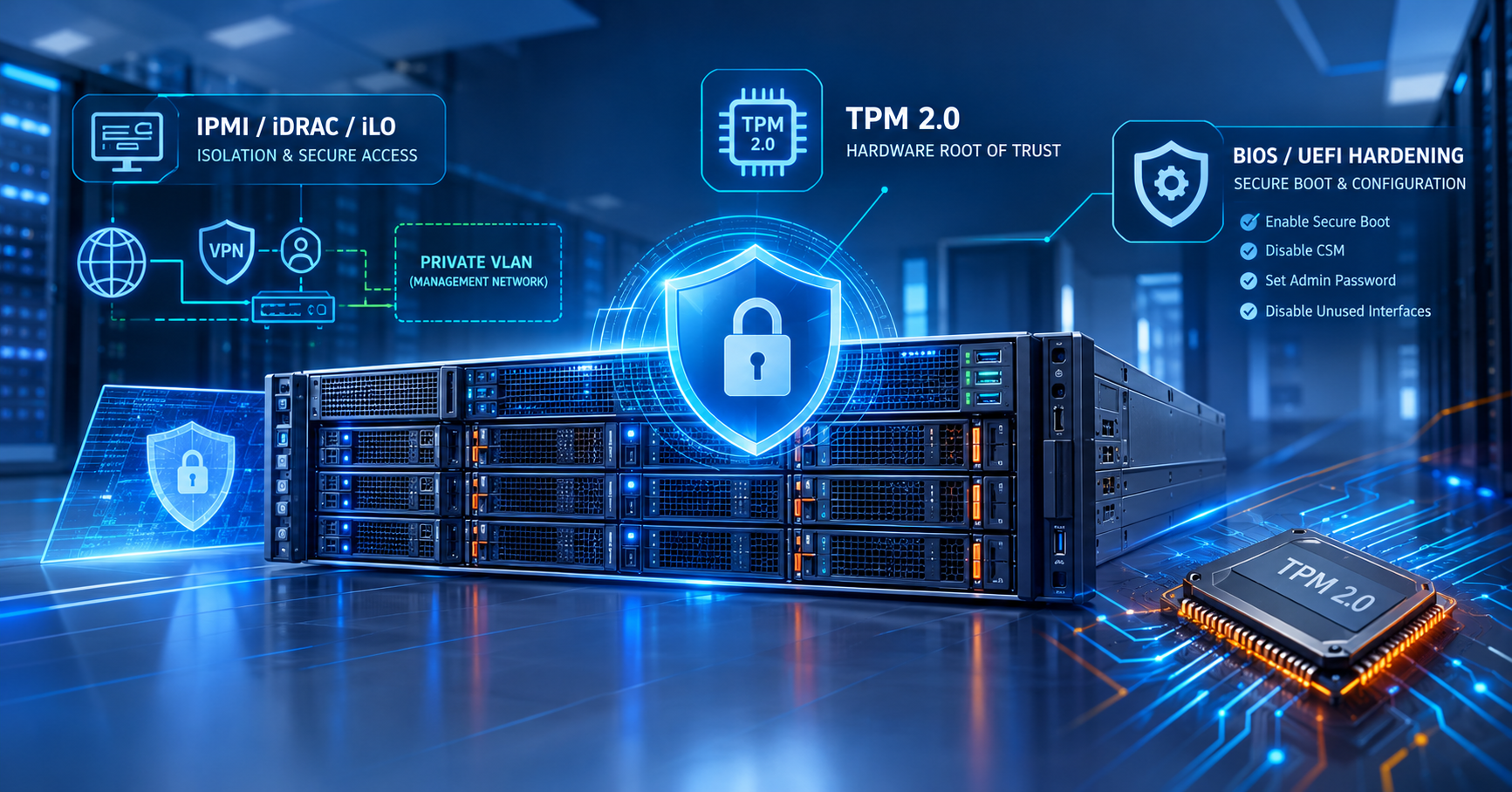
In high-assurance enterprise computing, operating system security alone is insufficient. Software firewalls and kernel patches operate on the assumption that underlying server hardware and firmware have not been compromised. Advanced persistence vectors, firmware bootkits, and supply-chain threats target pre-boot environments long before the operating system initializes.
- Out-of-Band Management Isolation (IPMI, iDRAC, iLO)
Baseboard Management Controllers (BMCs) provide raw hardware control, virtual media mounting, and power management. Exposing BMC interfaces directly to public internet routes allows unauthorized parties to bypass OS security layers entirely.
Private Network Segmentation: Isolate IPMI traffic on non-routable private VLANs.
VPN Enforcement: Require encrypted WireGuard or IPsec tunnels for management connections.
Access Controls: Replace default credentials with complex passwords and implement strict switch-level IP whitelisting.
Establishing Hardware Trust with TPM 2.0
A physical Trusted Platform Module (TPM 2.0) microcontroller provides hardware-isolated key storage. Integrated with Linux Unified Key Setup (LUKS) full-disk encryption, the TPM measures firmware and bootloader signature integrity during initial power-on. If malicious modifications are detected in the boot chain, the TPM refuses to unseal encryption keys, protecting stored NVMe data.UEFI Firmware Hardening
UEFI Secure Boot: Enforces signature validation on all pre-boot software binaries.
CSM Disabling: Disables legacy Compatibility Support Modules to enforce native UEFI execution paths.
Interface Restrictions: Locks UEFI configuration menus with administrative passwords and disables unused physical interfaces such as USB ports and PXE network booting.
EPY Host provisions bare metal dedicated servers with full administrative access to both software and low-level hardware environments, allowing organizations to implement comprehensive hardware-level security policies.
Read the complete technical breakdown on EPY Host:
🔗 https://www.epyhost.com/blogs/hardware-level-security-ipmi-tpm-bios/