Rogue Network: A Mining, Staking, and Gaming Stack Designed for Interconnected Participation
Navigating the Utility Gap with the Rogue Network Ecosystem
The digital asset landscape has reached a point of saturation where the novelty of "blockchain for the sake of blockchain" has largely worn off. Investors and participants are increasingly looking past speculative hype toward projects that demonstrate a coherent relationship between infrastructure and application.
The Rogue Network emerges as a response to this demand, positioning itself not merely as a ledger, but as a multi-layered environment where Proof-of-Work (PoW) security meets the interactive possibilities of a pirate-themed MMORPG. By integrating a dedicated EVM-compatible blockchain with a functional gaming economy, the project attempts to solve the persistent problem of user retention and network purpose.
So, What is Rogue Network
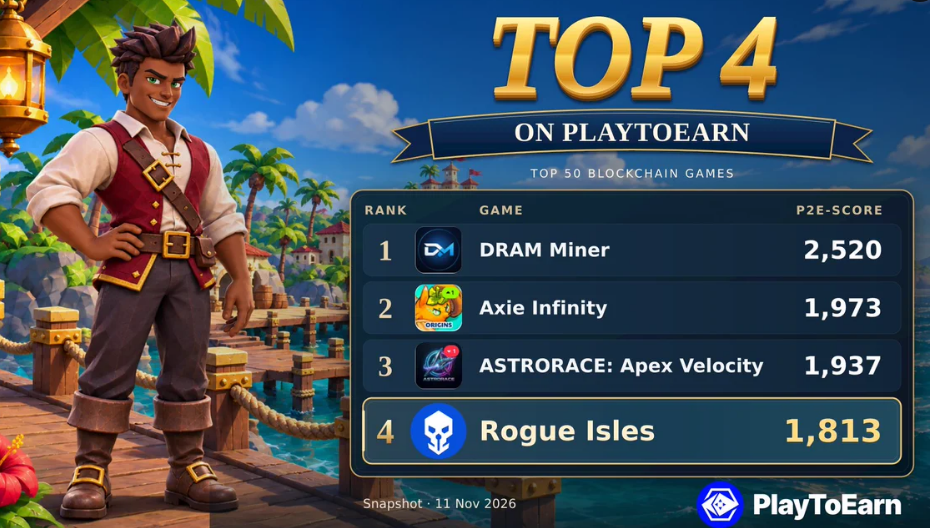
This project uses a spread-out system where many different computers all over the world help keep the records straight. This is often called a "Proof of Work" system. Think of it like a group of people all checking a math problem at the same time to make sure the answer is right. Because so many people are checking, it is very hard for anyone to cheat.
The network uses its own special coin called RGN to keep everything moving. You use these coins to pay for small fees when you send things to other people or when you want to use special features in the game. It is the fuel that keeps the whole engine running. By having its own coin and its own network, the project does not have to rely on other companies to stay online.
In practice, the Rogue Network operates as a dual-engine system. On one side, it provides a robust technological foundation characterized by Scrypt-based mining and smart contract execution. On the other, it hosts Rogue Isles, a persistent world where players can explore, trade, and develop skills. This structure ensures that the native RGN asset serves a functional role across various domains—from paying transaction fees on the network to acting as a potential reward mechanism within the gaming environment. This editorial explores the technical nuances of the Rogue Network and how its various components, such as the FORGE system and the Rogue Vault, create a unified ecosystem built for long-term viability.
Understanding the Core Concept of a Native Utility Layer At Rogue Network
To grasp what the Rogue Network represents, one must look at it as a sovereign infrastructure rather than a secondary layer on another chain. While many modern projects opt for the ease of launching as a token on an existing network, Rogue maintains its own blockchain. This independence allows for a customized consensus mechanism and a tailored economic model that isn't beholden to the congestion or fee structures of a parent network. The native RGN asset is the lifeblood of this system, providing the necessary incentive for miners to secure the chain while offering utility to users interacting with decentralized applications (dApps).
What this means in practice is a higher barrier to entry for the developers—who must manage a full network—but a more controlled and scalable environment for the end user. By ensuring EVM compatibility, the network allows developers to deploy familiar Ethereum-based tools and contracts while benefiting from the specific security profile of a PoW Scrypt algorithm. This hybrid approach bridges the gap between the historical reliability of mining-based networks and the modern flexibility of smart contract platforms.
The Technical Architecture of the Rogue Network Blockchain
At its foundation, the Rogue Network is built to handle the complexities of both high-frequency gaming interactions and secure financial transactions. The choice of a Proof-of-Work consensus mechanism using the Scrypt algorithm is a deliberate nod to decentralized security. Scrypt is well-known in the mining community for its memory-hard requirements, which historically provided a level of resistance against the extreme centralization seen in some early ASIC-dominated algorithms. By utilizing this for the Rogue Network, the project invites a broad base of mining participants to contribute to the network’s integrity.
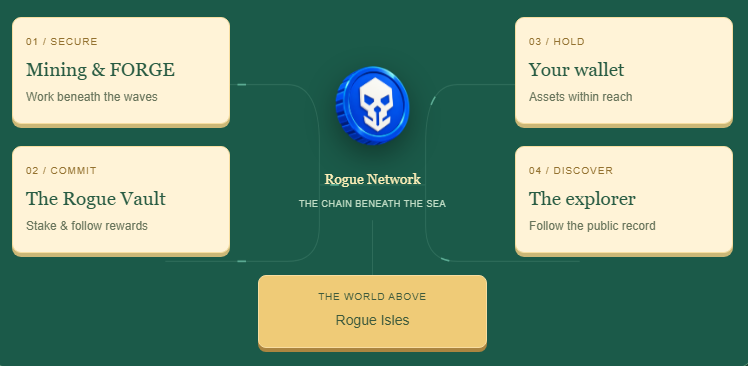
The technical specifications of the network are designed for a balance of speed and stability. Following the activation of the FORGE V5 update at block 1,121,800, the network target block time was adjusted to 12.5 seconds. This cadence is fast enough to support a responsive user experience in the Rogue Vault or during asset transfers, yet slow enough to ensure that block propagation remains consistent across a global network of nodes. With a Chain ID of 70088 and 18-decimal precision for the RGN asset, the network aligns with industry standards, making it easily accessible via popular tools like MetaMask or SafePal.
Continuity Through Evolution: The FORGE V5 Milestone
A common pitfall for developing blockchains is the need for "hard forks" that reset the state of the network, often erasing history or requiring complex migrations. The Rogue Network avoided this by ensuring that the transition to FORGE V5 preserved all existing accounts, balances, and contracts. This continuity is vital for establishing trust within the community. It demonstrates that the infrastructure can evolve—introducing more sophisticated treasury and mining mechanisms—without compromising the assets or history that users have already built on the chain.
FORGE: Reimagining Mining and Ecosystem Revenue
One of the most innovative aspects of the Rogue Network is the FORGE system. Most mining models are insular; they reward miners for securing their specific chain and nothing else. FORGE takes a more expansive view by coordinating external revenue from other established PoW networks. By identifying DigiByte (DGB) and Dogecoin (DOGE) as external mining sources—and recently adding support for SOQ—the FORGE system creates a nexus of cross-chain computational value.
This system works through a structured approval process that ensures the integrity of the rewards. Compatible miners contribute work through an integrated pool, and the system verifies this work against external mining requirements. To maintain a high security standard, a quorum of authorized signers must certify the mining templates before RGN validators process the state transition. This multi-step validation prevents fraudulent claims and ensures that only legitimate computational work results in the issuance of native rewards.
The Buyback and Burn Mechanism: Linking External Revenue to RGN
The ultimate goal of the FORGE architecture is to create a sustainable economic loop. When mining rewards from external chains mature, the treasury can use this revenue to perform buybacks of RGN from the open market. These tokens are then permanently removed from circulation through a burn process. While this is not an automated "on-the-fly" execution—it requires operational oversight and public recording—it provides a theoretical floor for the asset's economy by linking it to the broader PoW mining market. This creates a unique value proposition where the health of the Rogue Network is bolstered by the activity it facilitates across the wider crypto landscape.
A Transparent Blueprint for RGN Tokenomics
Transparency in token distribution is often the deciding factor in a project's credibility. The Rogue Network has established a clear lifetime gross issuance ceiling of 10.7 billion RGN. This figure is not an arbitrary number but a calculated limit that accounts for previously issued supply, reserved credits, and future subsidies. It is important to distinguish between this gross issuance and the actual circulating supply; the latter is influenced by staking locks, treasury holdings, and the aforementioned burn mechanisms.
The 40/30/20/10 Subsidy Distribution
The network’s emission model is designed to incentivize all types of participants simultaneously. Rather than giving all new tokens to miners, the block subsidy is split into four distinct paths:
- Mining (40%): This ensures that those providing the computational power to secure the ledger are fairly compensated, maintaining the network's decentralized defense.
- Staking (30%): By directing a significant portion of the subsidy to the Rogue Vault, the network encourages long-term holding and reduces market volatility.
- Play-to-Earn (20%): This allocation is reserved for the Rogue Islesgaming economy, ensuring that players have a tangible incentive to participate in the world.
- Treasury (10%): These funds are dedicated to the ongoing development, marketing, and operational costs of the ecosystem, ensuring the project has the resources to grow.
This balanced approach recognizes that a successful blockchain needs more than just miners; it needs a committed community of holders, an active user base of players, and a well-funded development team.
The Rogue Vault: Staking and Community Commitment
For those who prefer a less technical way to participate than mining, the Rogue Vault serves as the primary gateway for staking RGN. This application allows users to commit their assets to the network in exchange for a share of the block subsidies. The Vault is built with user experience in mind, offering a clear interface for staking, claiming rewards, and initiating withdrawals.
One of the critical features of the Rogue Vault is the withdrawal cooldown period. When a user decides to unstake their RGN, the funds enter a waiting phase before they can be collected. This is a common but essential security feature in blockchain staking, as it prevents sudden, massive outflows of liquidity that could destabilize the network. By providing visibility into active stakes, pending rewards, and cooldown status, the Vault offers a transparent environment for asset management.
Mining Infrastructure and the Rogue Mining Pool
While the Rogue Network is EVM-compatible, its heart remains in the Proof-of-Work model. To facilitate this, the project provides a dedicated mining pool infrastructure. This allows individuals with Scrypt-compatible hardware to contribute their hashrate without needing to set up complex, independent node integrations. The pool acts as a coordinator, distributing work and ensuring that payouts are recorded accurately on the blockchain.
This infrastructure distinguishes between several roles: the workers who provide the hashrate, the validators who run the node software to maintain the ledger, and the operators who manage the FORGE adapters. This specialization allows the network to scale effectively, ensuring that each participant can contribute in the way that best suits their technical capabilities and hardware resources.
Navigating the Ecosystem: Wallets and Transparency Tools
No blockchain ecosystem is complete without the tools to navigate it. The Rogue Network offers a suite of wallet options tailored to different user needs. For the average user, the Rogue Wallet for Android and the desktop versions (Windows, Linux, macOS) provide a graphical interface for managing balances. For more advanced users and developers, the Rogue CLI offers a terminal-based command-line interface for direct interaction with the blockchain and staking contracts.
Complementing these tools is Rogue Scan, the network’s official blockchain explorer. In the interest of total transparency, Rogue Scan allows anyone to audit the network in real-time. Users can verify transaction hashes, inspect the contents of wallet addresses, and track the progress of blocks. This level of public visibility is non-negotiable for a project aiming for institutional-grade credibility, as it ensures that all network activity is verifiable and permanent.
Deepwater Swap and the Multi-Chain Connection
As the ecosystem grows, the need for liquidity and asset exchange becomes paramount. Deepwater Swap serves as the decentralized exchange (DEX) for the Rogue Network. It provides the tools for native asset swaps and liquidity provision, allowing users to trade within the ecosystem efficiently. Furthermore, Deepwater Swap acts as a bridge in terms of market awareness, connecting the native RGN economy with the broader Solana market.
It is crucial for users to understand the distinction between native RGN and the RGN (SPL) token found on Solana. Native RGN powers the Rogue Network blockchain, while the Solana-based version is available for trading on Raydium.
For those ready to join the ecosystem, $RGN is currently accessible via the Solana network, providing a high-liquidity entry point.
To access the official exchange at Raydium and always confirm you are trading the correct asset by checking the token address: Cn7pt6uUQt6qdYSASpWgvQHm4D9aStaujRu7AYMABray.
While a bridge between the two is a planned future feature, they currently represent two different entries into the same ecosystem. This multi-chain presence allows Rogue to tap into the high liquidity of the Solana network while maintaining its specialized PoW infrastructure.
Rogue Isles: The Interactive Heart of the Network
While the technical infrastructure is impressive, the primary driver for many users is Rogue Isles. This pirate-themed MMORPG is not just a game with a token slapped on top; it is an integrated experience designed to leverage the Rogue Network’s capabilities. Currently in its Alpha phase, the game allows players to dive into a browser-based world of exploration and skill-building.
Gameplay Mechanics and Skill Progression
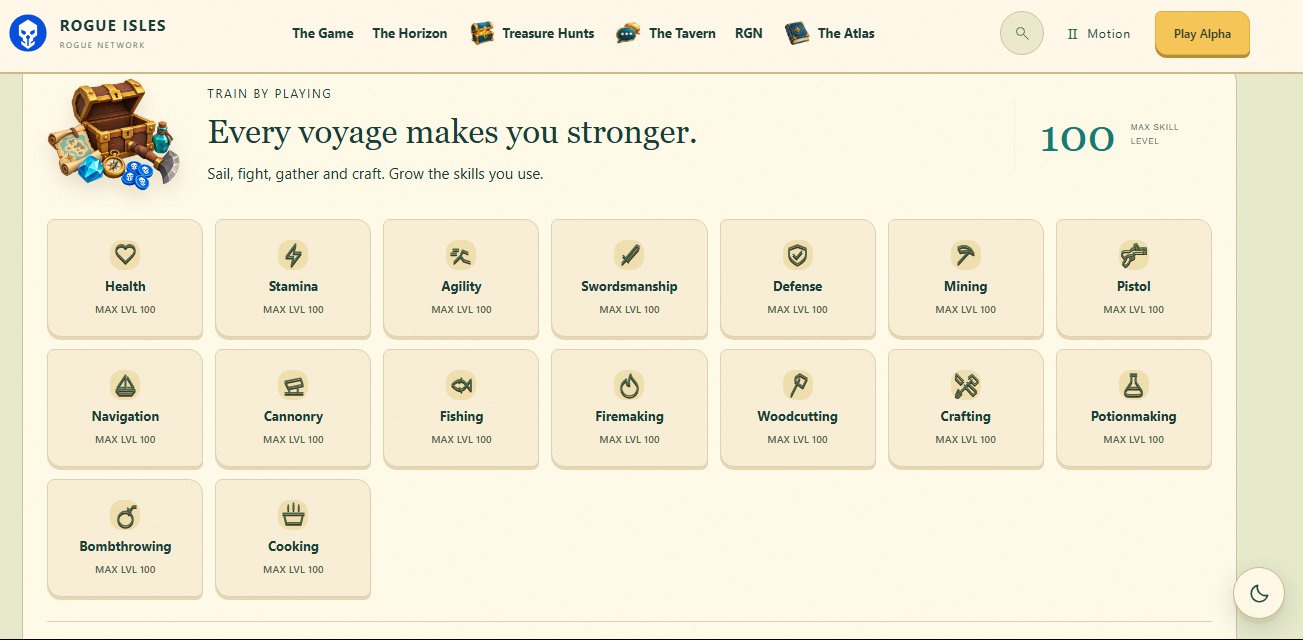
Rogue Isles focuses on a deep progression system. Players aren't just clicking buttons; they are developing a pirate persona through various skills:
- Navigation and Seamanship: Essential for traversing the vast digital oceans and discovering new islands.
- Combat and Strategy: Whether through swordsmanship or naval battle, players must defend their loot and their reputation.
- Resource Gathering: Skills like fishing, mining, and crafting allow players to interact with the world’s economy, gathering materials that can be traded or used to improve their standing.
- Social Structures: The game encourages the formation of crews and clans, fostering a community-driven environment where players must work together to achieve large-scale goals.
The Future of Digital Ownership: Private Islands
A major upcoming feature for Rogue Isles is the introduction of private island ownership. This represents a significant step in digital property rights within the game. Owners will likely have the ability to develop their land, create outposts, and potentially generate value from their holdings. This adds a layer of strategic investment to the gameplay, making the world of Rogue Isles feel persistent and consequential.
The Play-to-Earn Vision and Seasonal Rewards
The 20% block subsidy allocation for Play-to-Earn (P2E) is the cornerstone of the Rogue Isles economy. However, the project takes a more nuanced approach than the "click-to-earn" models of the past. Rewards are tied to achievement and exploration. The project has outlined "Treasure Seasons," where players must follow clues and explore the world to find hidden rewards. This gamified approach to token distribution ensures that RGN is earned through active engagement rather than passive exploitation, which is vital for the long-term health of the game's economy.
The Captain's Atlas: A Comprehensive Knowledge Base
To ensure that no participant is left behind, the project maintains the Captain's Atlas. This is more than just a FAQ; it is a deep-dive documentation center that covers everything from the basics of blockchain architecture to the specifics of ship management in Rogue Isles.
Whether you are a miner looking for pool connection strings, a developer seeking RPC endpoints, or a player trying to master the crafting system, the Atlas provides the necessary guidance. This commitment to education is a hallmark of a project that values its community's ability to participate effectively.
Official Project Resources
To stay updated on the latest developments or to join the community, refer to the following official channels:
- Social Media: X (formerly Twitter) | Telegram
In Conclusion
The Rogue Network is an ambitious attempt to unify the disparate worlds of high-end blockchain infrastructure and immersive gaming. By building its own EVM-compatible PoW chain, it has created a playground where technical security and creative gameplay can coexist. The success of the project will ultimately depend on its ability to maintain the momentum of its development roadmap—delivering on features like island ownership and the cross-chain bridge—while continuing to grow its community of miners and players.
In a market often characterized by fleeting trends, the Rogue Network’s focus on utility and structured economics offers a refreshing alternative. It is a project that asks its participants to do more than just hold a token; it invites them to mine, to stake, to explore, and to build a digital legacy in the world of Rogue Isles. As the ecosystem matures, it stands as a compelling example of how blockchain technology can be used to create a truly interconnected digital economy.
Author
Username: Rudelizeh
Wallet: 9gdkW29RLXh2pX8h6489eQtBN23m9Lxr5BfpqeskPjwF