Beyond the Headline: One Wrong Wallet Address Is Enough
Consider the small detail behind this question: the address deserves a second look. A familiar crypto interface often encourages a quick decision. A person checks a number, notices the button and expects the rest of the process to be obvious. But important distinctions sit behind ordinary-looking fields. This is particularly true with Ethereum, where a transfer can be publicly verified while the assumptions behind a third-party order remain much less visible. The Owlmix exchange interface asks for an Ethereum payout address before an order is created. There is a difference between a service saying something and the reader knowing exactly what the statement entails. That difference deserves space before any irreversible transaction.
The overlooked distinction
An Ethereum address is a routing instruction, not a nickname. Copying it incorrectly can direct value to an unintended destination after a transaction becomes final. The phrase sounds straightforward until it is placed beside the actual steps of a transaction. The chain records an observable event, whereas the service sets separate conditions for its own actions. Confusing the two can cause users to rely on information that was never intended to answer the question they have.
A concrete example
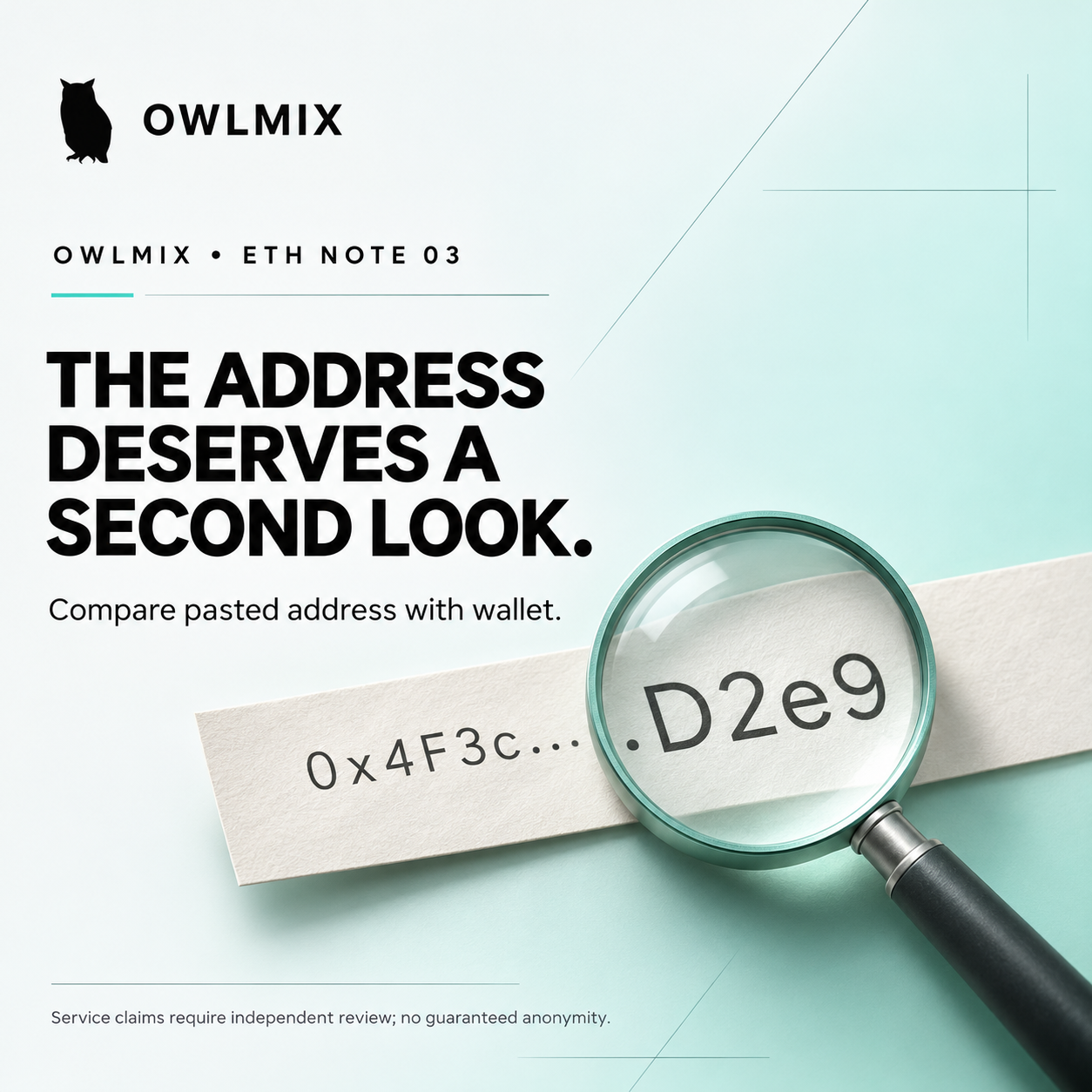
A pasted string may look plausible at first glance, especially when the visible first and last characters match a previously used address. Clipboard interference and accidental selection are both reasons to compare it with the wallet itself. This is not a claim about a particular user's experience or evidence that an Owlmix order failed. It is a practical illustration of why the relevant field or description deserves attention before a transfer. The same basic mistake can occur even in a polished, familiar interface.
What Owlmix actually publishes
For Owlmix, the relevant published point is specific: The Owlmix exchange interface asks for an Ethereum payout address before an order is created. The source is the service's own materials, so the wording should be read as a description of its stated model rather than proof that every operational claim has been independently audited. The current interface and terms should take priority over an older screenshot. A useful reader will also verify the official domain, because copying a logo requires no access to the service's infrastructure.
The part that still needs judgment
A signed order record may help establish what was entered, but it cannot undo a transfer routed to a wrong address. A few seconds of verification are more useful than relying on a familiar display label. It helps to ask what is being certified and by whom. A PGP signature can authenticate signed content against a trusted key, but it cannot certify a reserve balance or make blockchain history disappear. A directory listing may provide context, but a small collection of reviews cannot settle every risk question.
A practical routine
Check the complete payout address in the wallet, confirm native ETH compatibility and record the actual destination before sending. Three short checks can make this repeatable: first, compare pasted address with wallet; second, confirm native eth receiving support; and third, recheck before funding. Record the outcome where appropriate, especially if funds are moved through a third party and the original information may not remain visible later.
Where the topic fits in a wider privacy discussion
Ethereum's publicly readable ledger is useful for verification, but publicity is also why privacy claims require care. A person can seek to limit unnecessary disclosure while continuing to keep appropriate financial records. A few seconds of verification are more useful than relying on a familiar display label. The useful question is not whether a promotional phrase sounds reassuring, but whether the remaining uncertainty is properly understood.
What to remember
Good product education begins by slowing down the interpretation, not the technology. A precise explanation can prevent two unlike concepts from being blended into one reassuring word. What matters is which part of the experience is verifiable, which part is controlled by another party and which part depends on a claim made by the provider.
The best outcome of this exercise is a better question before the next ETH transaction. Which address-check habit is easiest to maintain? Owlmix's published information can be examined at https://owlmix.cc/ and its PGP public key at https://owlmix.cc/pgp. Read those materials critically, verify the terms on the actual day of use and keep the legal and custody questions in view.
Why careful language also improves trust
One of the less obvious problems in cryptocurrency marketing is that convenience, privacy, authenticity and settlement are often packed into one sentence. They should be treated as different questions. Convenience asks how much effort the interface requires. Authenticity asks who issued the instructions. Settlement asks whether the expected transfer happened. Privacy asks what observers can infer from available data. The answer to one cannot automatically answer the other. An Ethereum address is a routing instruction, not a nickname. Copying it incorrectly can direct value to an unintended destination after a transaction becomes final. This distinction makes a description more credible, not less attractive, because readers can understand its exact scope.
A useful comparison is to ask what would count as contrary evidence. If a claim concerns a signed letter, test the signature against a trusted public key. If it concerns a published fee, inspect the current fee table. If it concerns an on-chain transfer, open the appropriate Ethereum transaction record. If it concerns a reserve or security promise, ask whether an independent audit exists rather than inferring it from a website counter. A signed order record may help establish what was entered, but it cannot undo a transfer routed to a wrong address. These are ordinary verification habits, and they keep a short promotional sentence from doing more work than the evidence allows.
Explore the published Owlmix terms: https://owlmix.cc/
PGP public key: https://owlmix.cc/pgp