Film Review: Circus (2000)
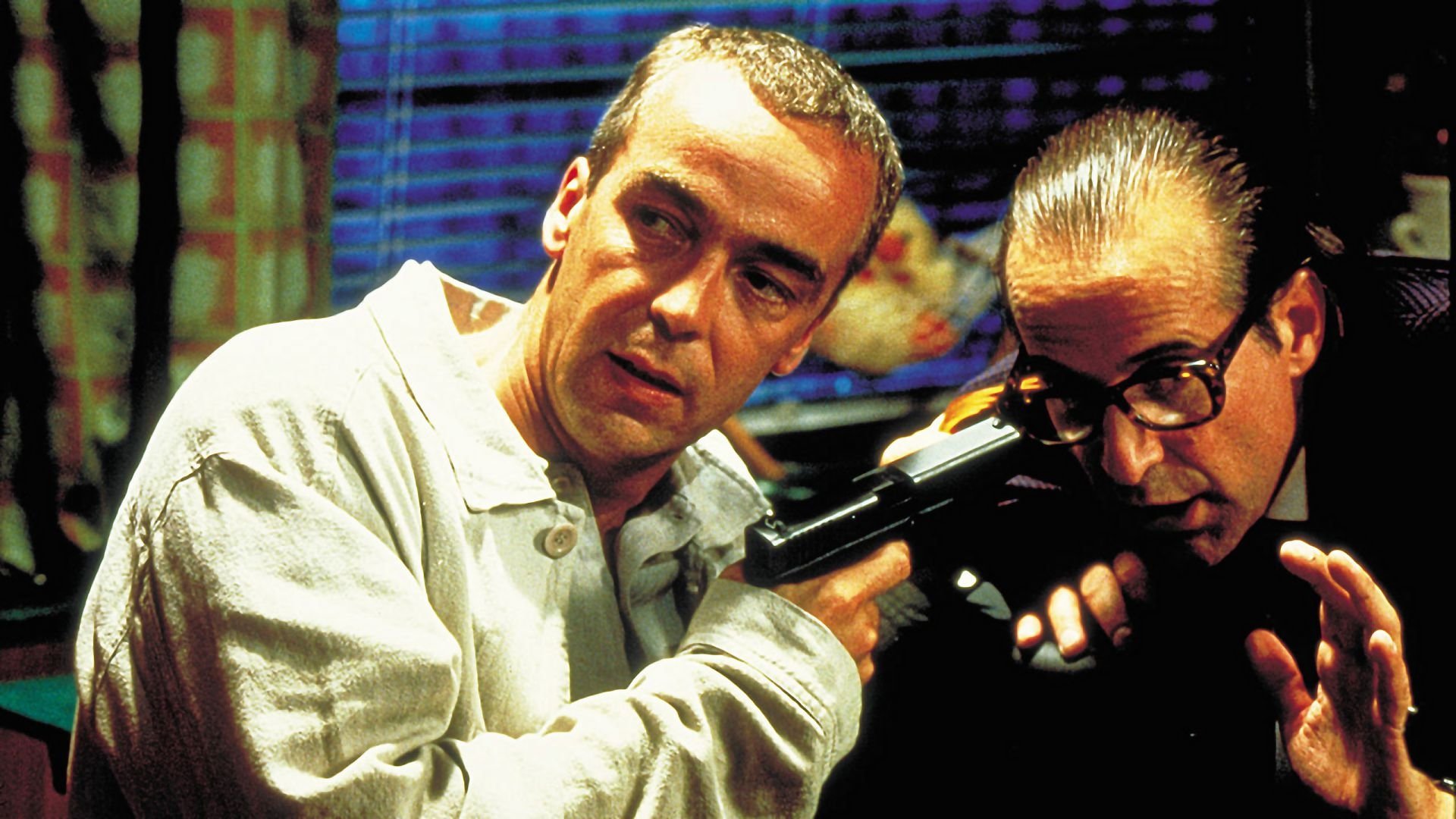
Circus was sold to the trade press as the work of "the British Tarantino", a title the producers defended by pointing out that David Logan had begun his working life behind the counter of a Brighton video shop. It is a charmingly cynical piece of biography-as-aesthetic: the man once rented out the tapes, therefore the man is Quentin. The genre proximity to Pulp Fiction is real. Everything else is not.
What Logan has actually taken from the source is a single principle, and he has taken it to an absurd degree: if a little is good, more must be better. The result is a script overstuffed with vivid grotesques played by character actors hired for their coolness, and with a higher density of dramatic reversals than any picture of comparable length from that year. Leo (John Hannah) and Lilly (Famke Janssen) are Brighton grifters, in love, dreaming of one last score and a quiet retirement. Leo's gambling habit keeps them in hock to the loan shark Troy (Eddie Izzard), who materialises at inconvenient hours to remind him. Rescue appears to arrive when the sadistic businessman Bruno (Brian Conley) hires Leo to manage his casino — except Bruno is himself in trouble with the Inland Revenue and means to park a two-million-pound liability on Leo's shoulders. Leo, meanwhile, is arranging the murder of Bruno's wife with the transvestite Julius (Peter Stormare). Lilly is being leaned on by her violent ex, the American bank robber Elmo (Fred Ward). And all of them will be dragged eventually into the orbit of Bruno's thick brother Caspar (Ian Burfield) and his thicker, more lethal bodyguard Moose (Tiny Lister Jr.).
That is a great deal of plot, and it is delivered at the volume of a man shouting to be heard over his own influences. The trouble is not the quantity of the reversals but their poverty of variation. Every one of them reduces to a single motif — nobody is what they seem, and everyone is diddling everyone else — so that tripling the idea does not deepen it, it flattens it into a pattern. In more dextrous hands this could have played as a likeable farce; Robert Walker, a British director with few features and no evident comic instinct, instead makes it opaque and, well before the halfway mark, simply tiring. Worse still, the reversals become transparent as the running time advances, and a viewer with the least experience of the genre will have solved the third act long before the film catches up. For a caper built almost wholly on rug-pulls, that is close to fatal.
And yet. Two or three stretches of it are genuinely brilliant, and I said so at the time. Chief among them is Izzard, playing the pop-music-obsessed moneylender with a loopy, wayward charm that briefly convinces you the rest of the picture might rise to meet him. It never does. Izzard stands out partly because his is the only role with any real comic architecture, and partly because the surrounding cast is so comprehensively squandered. A cast list containing Hannah, Janssen, Stormare, Ward, Donohoe and the late Tiny Lister is not a list to waste, and yet the film finds a way: everyone is agreeable and nobody is given a character worth the labour of building. Hannah and Janssen in particular have charm to spare between them and nothing to spend it on.
On the technical side the film is glossy and anonymous. Seresin's photography and Boswell's score do the job and leave no fingerprints, and the Brighton locations function less as a place than as a credential — a way of signalling "this is real, this is the seaside, this is not Los Angeles". Costume and design are period-correct to the point of invisibility, which is to say they are fine.
It is not a bad movie so much as a superfluous one — a competent, occasionally charming, ultimately unilluminated attempt to wring one more drop from a source that had been squeezed dry years earlier, and to do so in direct competition with Guy Ritchie, who had far better claim to the "British Tarantino" tag and got there first. Its value now is documentary. If you want to know precisely what the post-Lock, Stock British crime boom looked like at the moment it began to run out of road, Circus is a useful specimen: the haircuts, the quips, the pier, the contract killing, the tax fraud, and, crucially, none of the exhilaration.
Rating: 4/10
Blog in Croatian https://draxblog.com
Blog in English https://draxreview.wordpress.com/
InLeo blog https://inleo.io/@drax.leo
Substack https://draxster.substack.com/
BTC donations: 1EWxiMiP6iiG9rger3NuUSd6HByaxQWafG
ETH donations: 0xB305F144323b99e6f8b1d66f5D7DE78B498C32A7
BCH donations: qpvxw0jax79lhmvlgcldkzpqanf03r9cjv8y6gtmk9
Leo and Lilly are a decent couple, but they seem to be running away from loan sharks, killers, and other unsavory characters almost constantly. The dialogue is quick and snappy, but the whole endeavor becomes so preposterous that it becomes hard to take it seriously. If you dig British crime movies from this period, you might want to check this one out, but it’s not exactly a masterpiece by any means. It’s more like a diluted Snatch or Pulp Fiction. At any rate, it’s probably worth your time if you have nothing better to do on a rainy Saturday night.