MLM Software for Small Businesses: A Practical Guide to Automation and Growth
Starting an MLM or direct selling business often begins with a small team, a few products, and a simple compensation structure. At this stage, managing distributors and commissions manually may seem manageable.
But as the network grows, spreadsheets and manual processes can quickly become difficult to maintain. Distributor records, sales, commissions, payouts, genealogy, and reports all need to be accurate and up to date.
This is where MLM software can make a difference. It helps automate repetitive tasks, organize business operations, and give both administrators and distributors better visibility into the network.
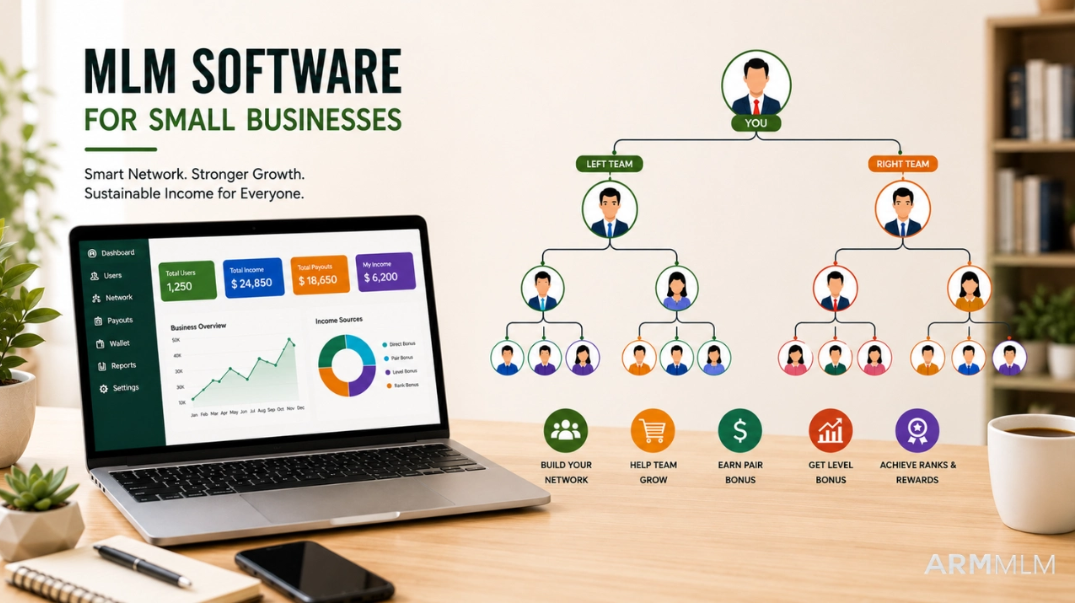
What Is MLM Software for Small Businesses?
MLM software is a business management platform built specifically for network marketing and direct selling companies.
For a small MLM business, it provides a centralized system for managing important activities such as distributor registration, network structures, sales, commissions, payouts, and reporting.
Instead of maintaining separate spreadsheets for different parts of the business, administrators can manage operations through a single platform.
Depending on the software, businesses may have access to features such as:
- Distributor management
- Genealogy management
- Commission calculation
- E wallet
- Sales and order management
- Rank management
- Reports and analytics
- Payment integration
- KYC management
- Replicated websites
- Mobile access
The goal is not simply to add more technology to the business. It is to make everyday MLM operations easier to manage and more reliable.
Why Small Businesses Need MLM Software
A small network may initially have only a handful of distributors. As more people join, however, the amount of data that needs to be managed increases rapidly.
For example, calculating commissions manually becomes more complicated when there are multiple bonus types, qualification requirements, levels, and sales conditions.
Similarly, tracking the genealogy of a growing distributor network through spreadsheets can become confusing.
MLM software can automate these processes and provide a structured way to manage them.
Reduce Manual Work
Automation can handle repetitive activities such as commission calculations, distributor registration, transaction tracking, and reporting.
This allows business owners and administrators to spend less time on administrative work and more time developing products, supporting distributors, and growing the business.
Minimize Calculation Errors
Commission calculations need to be accurate because they directly affect distributor earnings.
MLM software applies predefined compensation rules to calculate commissions and bonuses. This can reduce the risk of errors associated with manually calculating payments.
Centralize Business Data
Instead of keeping distributor information, sales records, commission data, and payment information in different files, a centralized platform keeps important business data organized in one place.
This makes it easier for administrators to find information and monitor business activity.
Important Features of MLM Software
Small businesses do not necessarily need every advanced feature available in the market. The focus should be on choosing software that provides the functionality required by the business model.
Distributor Management
Distributor management is one of the core functions of MLM software.
Administrators should be able to create and manage distributor accounts, view profiles, monitor activity, manage sponsor relationships, and track important account information.
Distributors should also have access to their own dashboards where they can view relevant information about their business.
Genealogy Tree
The genealogy tree shows how distributors are connected within the network.
It allows administrators and distributors to view uplines, downlines, placements, and team structures.
As the network becomes larger, having a visual representation of the organization can make network management significantly easier.
Commission Management
Commission management is another essential component.
The software should support the compensation structure used by the business and automatically calculate commissions based on configured rules.
Depending on the business model, this could include commissions based on personal sales, team sales, levels, ranks, bonuses, or other performance conditions.
E Wallet
An e wallet provides distributors with a convenient way to monitor their earnings and transactions.
They can potentially view their available balance, commissions, bonuses, withdrawals, and transaction history from their dashboard.
This also gives administrators better control over distributor payment records.
Sales Management
For product based MLM businesses, sales management is particularly important.
The software can help track orders, purchases, distributor sales, customers, and product activity.
Having sales information connected with the distributor network can also make commission processing more efficient.
Admin Dashboard
An administrator dashboard provides a central view of the business.
Depending on the system, administrators may be able to monitor:
- New distributor registrations
- Sales
- Orders
- Commission activity
- Withdrawals
- Network growth
- Distributor performance
- Rank achievements
Having this information available in one place can make day to day decision making easier.
Reports and Analytics
Reports allow business owners to understand how their MLM operation is performing.
Common reports include sales reports, distributor reports, commission reports, payout reports, and network growth reports.
These insights can help identify areas that require attention and provide a clearer picture of overall business performance.
Replicated Websites for Distributors
A replicated website can be useful when a small MLM business wants to give distributors their own online presence.
Instead of asking every distributor to create and maintain a separate website, the company can provide a standardized website structure that is connected to the distributor's account.
The distributor can then use the website to promote products or introduce potential customers to the business.
If you want to understand how this model works in practice, see our guide on what a replicated website is in MLM software.
Mobile Access for Distributors
Modern distributors often manage their businesses through smartphones.
They may want to check commissions, view their genealogy, monitor sales, or review transactions without sitting in front of a desktop computer.
A mobile responsive MLM platform can make these activities more convenient.
Businesses that need a dedicated mobile experience can also consider MLM mobile app development to provide distributors with access to important business functions through their smartphones.
How Automation Helps Small MLM Businesses
The main advantage of MLM automation is that it allows a small team to manage processes that would otherwise require significant manual effort.
Consider commission processing as an example.
Without automation, administrators may need to collect sales data, identify eligible distributors, calculate different commissions, verify the results, and prepare payouts.
With an automated system, these rules can be configured within the software and applied according to the business's compensation structure.
The same principle can be applied to distributor management, genealogy, reporting, and other repetitive operations.
How Much Does MLM Software Cost?
There is no single price for MLM software.
The cost depends on factors such as:
- Compensation plan
- Number of distributors
- Customization requirements
- Payment integrations
- Mobile application requirements
- Hosting
- Additional modules
- Support and maintenance
For a small business, the cheapest option is not always the most cost effective choice.
A platform that appears inexpensive initially may become expensive if it requires extensive customization later or cannot support network growth.
It is better to evaluate the overall value, usability, scalability, and support provided by the software.
How to Choose MLM Software for a Small Business
Before selecting a platform, start by identifying exactly what your business needs.
Define Your Compensation Plan
Your software should support the compensation plan you intend to use.
Whether your business uses a binary, unilevel, matrix, hybrid, or another structure, confirm that the software can handle the required commission rules.
Check Ease of Use
The platform should be simple enough for both administrators and distributors to understand.
A complicated interface can reduce adoption and increase the amount of support required.
Evaluate Automation
Look at which processes can actually be automated.
Commission processing, payouts, genealogy management, registration, reporting, and notifications are common areas where automation can save time.
Consider Scalability
Your software should not only work for your current network.
Think about where your business could be in two or three years. The platform should be capable of supporting more distributors, transactions, products, and markets as the business grows.
Review Security
MLM platforms can handle sensitive distributor, financial, and business information.
Before choosing a provider, evaluate available security measures, access controls, authentication, data protection, and payment security.
Test the Software
A live demo can help you understand whether the platform actually fits your business.
Ask the provider to demonstrate the areas that matter most to you, especially distributor registration, genealogy, commission processing, payouts, reports, and administration.
Common Mistakes to Avoid
Small MLM businesses sometimes choose software based only on price or the number of features advertised.
This can lead to problems later.
Avoid choosing a platform without checking whether it:
- Supports your compensation plan
- Can scale with your network
- Provides adequate reporting
- Offers reliable technical support
- Supports your required payment methods
- Provides appropriate security
- Allows necessary customization
- Is easy for distributors to use
A platform should solve your operational problems rather than create additional complexity.
Can MLM Software Help a Small Business Grow?
MLM software cannot replace a strong product, effective marketing, or distributor engagement. However, it can provide the operational foundation needed to support growth.
As the number of distributors increases, automation can help the business manage more registrations, transactions, commissions, and reports without relying entirely on manual processes.
This allows the company to build standardized workflows that can continue working as the network expands.
Final Thoughts
For a small MLM or direct selling business, managing everything manually may work in the beginning, but it becomes increasingly difficult as the network grows.
MLM software for small businesses provides a centralized way to manage distributors, sales, commissions, payouts, genealogy, and reporting while reducing repetitive administrative work.
The right solution should be easy to use, support your compensation plan, provide the features your business actually needs, and have enough flexibility to grow with you.
Rather than choosing software simply because it has the longest feature list or lowest price, focus on finding a platform that fits your current operations and provides a reliable foundation for future growth.