Joseph Schippers (1881–1904)
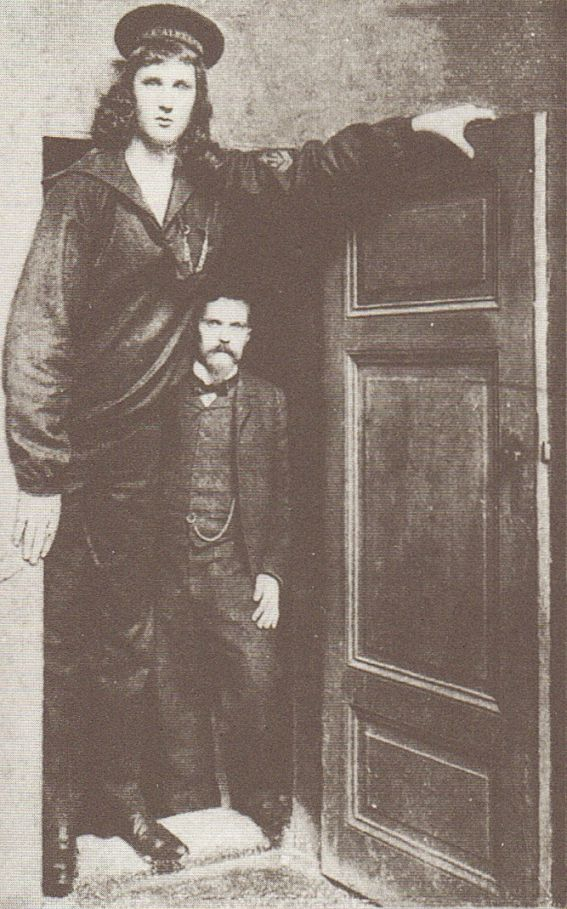
Joseph Schippers (1881–1904) NOT THE SAME PERSON AS NOR RELATED Joseph Schippers (1888–1948),
The man in this image is Joseph Schippers (1881–1904), a German man who was often promoted as a "giant" during the turn of the 20th century. He was known by several stage names, including "Der lange Josef" (Long Joseph) and "The Great Joseph".
Key Facts About Joseph Schippers:
Professional Background: He was a well-known performer at the Berliner Panopticum, a famous wax museum and entertainment venue in Berlin, Germany.
Height: While height claims for such historical figures were often exaggerated for show business, he was a person of exceptional stature, typically billed as being around 8 feet tall (approx. 2.4 meters).
The Photograph: This specific image, often dated to around 1903, is a classic example of "giant" photography from that era. It utilizes a common technique where a very tall person poses next to a person of average height (and sometimes a standard-sized door) to emphasize their scale.
Attire: He is frequently pictured in the sailor uniform seen here, which was part of his public persona and performance attire.
They are not the same person, and there is no evidence they were related. The confusion often stems from the fact that they shared the same name and both lived in Germany during the same era.
Joseph Schippers (1888–1948) – "Der lange Josef"
This is the man in your images.
Early Life: Born on April 15, 1888, in Mönchengladbach, Germany.
Claim to Fame: He was a famous "giant" and soldier in the 1. Garde-Regiment zu Fuß (1st Foot Guard Regiment) in Potsdam.
Career: After his military service, he became a successful entrepreneur, co-founding Schippers & van der Ville, a company that built large-scale fairground rides, including the world's largest portable roller coaster at the time.
Joseph Schippers (1881–1904) – The Mystery Giant
There are some online records of a "Joseph Schippers" who supposedly died in 1904 at a young age, often cited as a "giant" performer at the Berliner Panopticum. However, historical data for this specific individual is sparse and frequently conflated with the famous "Der lange Josef" (1888–1948).