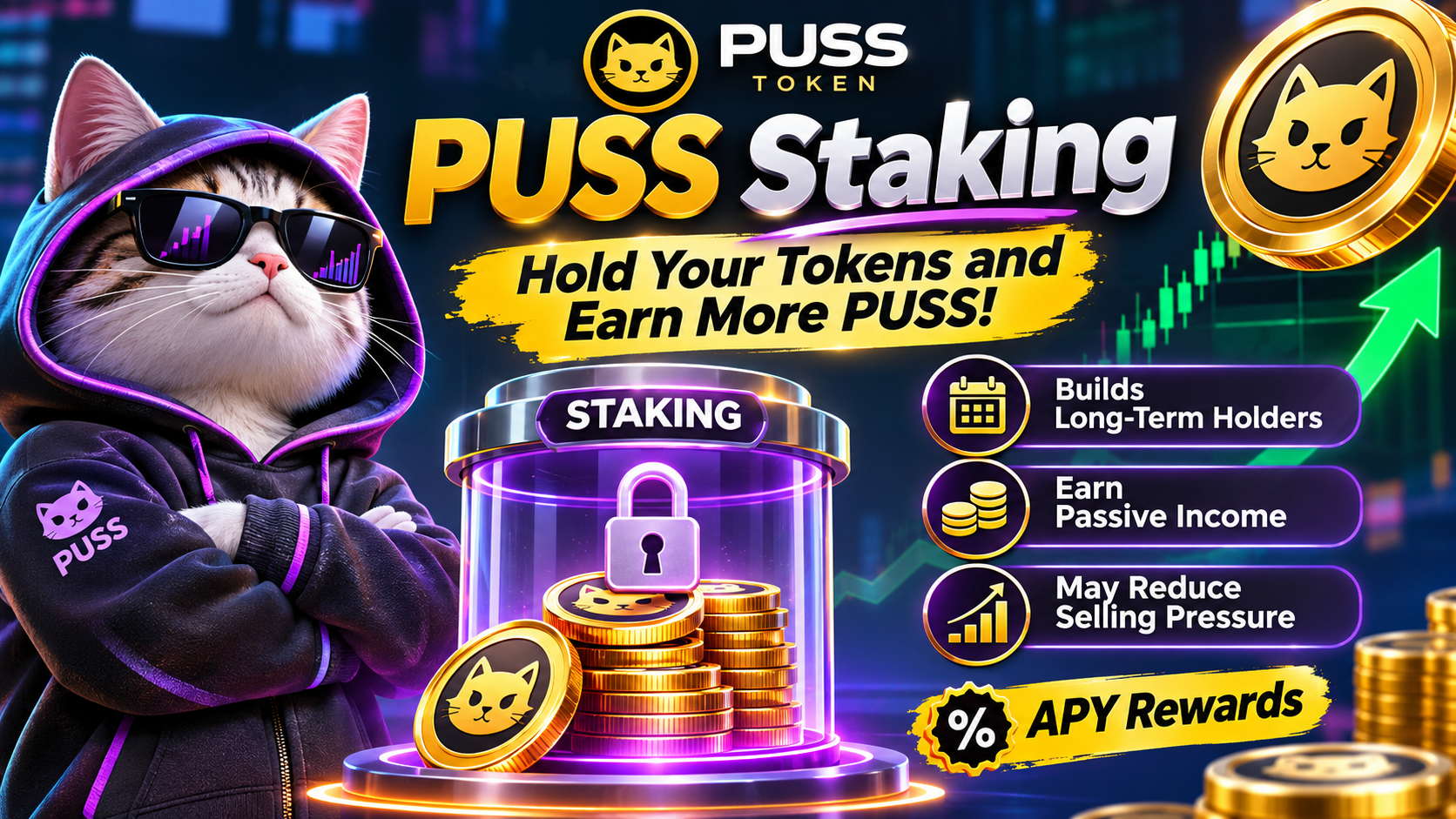
PUSS Staking: Hold Your Tokens and Earn More PUSS! 🐱💰
How is everyone doing? I hope you are all doing well. Today, I want to discuss a very important topic with you.
I’m going to talk about a concept that—to my knowledge—was part of the PUSS roadmap and was, in fact, launched at one point. It appears to be inactive at the moment.
So, today’s topic is PUSS staking. I will explore what it would look like if PUSS staking were to be reintroduced, what changes might be involved, and how the whole process would function.
What is PUSS Staking?
Simply put, it’s a form of an airdrop—a type of event often used to attract crypto holders and investors. Staking involves locking your tokens for a specific period, in exchange for which you receive rewards based on the amount of tokens you have staked.
This reward system is known as APY (Annual Percentage Yield); the more tokens you hold and stake, the higher the APY you earn.
image ai generated
What are the benefits of reintroducing PUSS staking?
1. It fosters long-term holders.
First and foremost, it encourages long-term token holding. Investors are more likely to hold their tokens for an extended period in anticipation of earning rewards.
This, in turn, increases the number of PUSS holders.
2. It creates a new opportunity for passive income.
PUSS holders no longer need to just leave their tokens sitting idle in their accounts. Instead, alongside simply holding the tokens—usually in the hope that their value will increase over time—they can also earn rewards through staking. With this staking system in place, holders can generate passive income by staking their tokens.
3. Potential Reduction in Selling Pressure
As investors hold their tokens for longer periods, selling pressure will decrease. Furthermore, increasing the APY could incentivize investors to purchase and hold even more tokens.
image ai generated
How It Works
Generally, there are two main types of staking. In some models, tokens cannot be unlocked before a predetermined period. In others, tokens can be unlocked at any time, allowing users to claim their staked assets along with any accrued rewards.
Typically, rewards for such staking programs are drawn from a dedicated portion of the token supply, which is gradually distributed to users through staking events.
Many projects also implement fixed-term lock-up periods, where users are unable to unlock their tokens before the specified time expires; the tokens are then unlocked automatically. These lock-up periods can range from 3, 7, 15, or 30 days to even longer durations.
Projects often utilize the capital (in dollar value) from these staked tokens for various operational activities. The returns and profits generated from these activities are then distributed back to the users, while the project retains a portion of the profits.
I hope this is clear. I will conclude here for today—take care, everyone!
https://x.com/Rakib_7p/status/2125249512742752323?a=RuaJ7DSuEcdb9hYMQlc&s=19
https://x.com/Rakib_7p/status/2125249735846220187?a=u2zg8z08lCuFaqsof7g&s=19
https://x.com/Rakib_7p/status/2125249512742752323?a=RuaJ7DSuEcdb9hYMQlc&s=19