The Tiny RNA Molecules That May Help Explain Some Genetic Disorders
Hello to all the readers of Commenta La Notizia, the home of FREE INFORMATION.
Before moving on to today's new topic, I would like to remind those who may not be aware that, just as I have done in the past with other similar systems, I am currently investigating everything surrounding the Steem/Steemit project. In particular, I am looking into its internal dynamics, the various groups involved, and the details of how they operate. Don't worry, some questionable aspects have already come to light. This is precisely why I invite you to support this project, because FREE INFORMATION must never be censored. Yet some people still seem determined not to understand this. Now, let's move on to today's new topic...
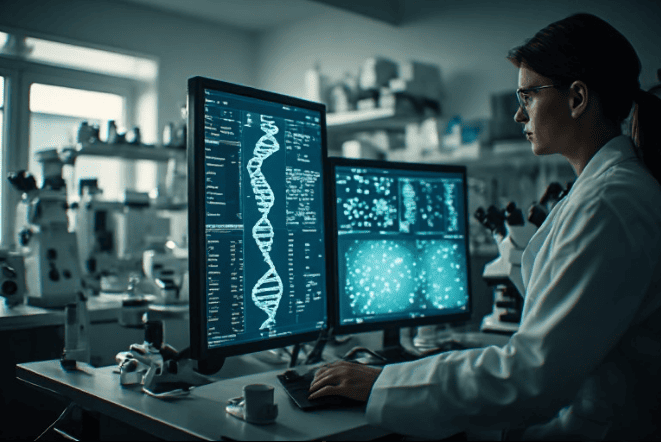
One of the most frustrating things about genetic medicine is that sometimes a person can go through a long series of tests and still be left without a clear answer. Doctors may suspect a genetic condition, the symptoms may fit a recognised pattern, and yet the results do not reveal the cause. It is tempting to think that the answer must be hidden somewhere in a protein-coding gene. But the genome is more complicated than that, and some of the most interesting discoveries are now coming from places that used to receive less attention. Small nuclear RNAs, or snRNAs, are a good example. They do not make proteins themselves, but that does not make them unimportant. They help cells process genetic messages before those messages are ready to be used. If this process goes wrong, the effects can reach far beyond the small RNA molecule where the problem began. A useful way to understand their role is to think about editing a document. DNA contains the original information, but the cell has to process the first RNA copy before it can be used to produce many proteins. Some sections need to be removed and the remaining parts joined in the right order. This is called splicing. SnRNAs work with proteins in a molecular system called the spliceosome, helping the cell recognise the right places and carry out the process. That may sound like a very small task, but biology depends on details. If the wrong pieces of an RNA message are joined, the cell can end up with a faulty instruction. In certain circumstances, a change in an snRNA gene can therefore contribute to disease, even though the gene does not encode a protein. This is why researchers are paying more attention to non-coding parts of the genome. A review published in Nature Genetics in 2026 examined disease-associated variants in 12 snRNA genes linked to Mendelian disorders. The reported conditions include neurodevelopmental difficulties, developmental abnormalities and retinitis pigmentosa. These findings are a reminder that genetic information is not useful only when it tells a cell which protein to build. The machinery that processes that information matters too.
RNU4-2 is one example that has attracted interest. Specific variants in this gene have been associated with a neurodevelopmental disorder. The important point is not that RNU4-2 explains every case that doctors cannot diagnose. It does not. Rather, it shows that a relevant genetic cause may sit outside the regions examined by tests focused on protein-coding DNA. That distinction matters for families who have already received a negative result. Exome sequencing concentrates on the parts of the genome that encode proteins. It is a powerful tool, but it does not provide a complete view of every non-coding region that may be medically relevant. Whole-genome sequencing examines a much broader range of DNA, while RNA studies can sometimes help researchers understand whether a variant affects the way genetic messages are processed. Of course, collecting more data is not the same as understanding more. A newly discovered variant may be harmless, or its effect may still be uncertain. Scientists need evidence that links a particular change to a biological mechanism and, ultimately, to a patient’s clinical condition. This is one of the reasons that modern genetic medicine needs both advanced technology and careful interpretation. Long-read sequencing, multi-omics and improved bioinformatics are expanding what researchers can examine. These methods can help reveal changes that are difficult to detect with conventional approaches, but they also create new challenges. Laboratories need reliable quality standards, clinicians need access to specialist expertise, and families need clear explanations of what a result does and does not mean. The subject was discussed at the Italian Society of Human Genetics congress in Rimini, where Stylianos Antonarakis gave an opening lecture on snRNA genes and Mendelian disorders. The wider message was about the changing boundaries of genetic diagnosis: the goal is not simply to sequence more DNA, but to identify which information is relevant and use it responsibly.
I think this is the most interesting part of the story. The promise is not a miracle test that will suddenly solve every unexplained condition. It is the possibility that some people may eventually get answers because researchers are looking at parts of the genome that were previously overlooked or harder to interpret. And finding an answer can matter even when there is no targeted treatment available. It may help a family understand what has happened, support genetic counselling and provide a clearer basis for follow-up care. At the same time, identifying a genetic cause does not automatically mean that a cure exists. Moving from discovery to treatment requires further studies and careful testing. The future of this field will depend on whether researchers can turn these findings into reliable clinical tools. That means validating variants, understanding their biological effects and determining when additional testing is genuinely useful. It also means making sure advanced diagnostics are used appropriately rather than simply because more technology is available. The genome is not just a collection of instructions for making proteins. It is also a system for processing, regulating and using those instructions. SnRNAs are a small but important part of that system, and studying them could help explain some conditions that have remained difficult to diagnose. For people still waiting for answers, that is a meaningful possibility. It is not a guarantee, and it should not be sold as one. But in genetic medicine, sometimes progress begins when researchers learn to ask a different question — and look in a different place. A more detailed version of this topic, including the scientific background and the latest research, is available on my blog for readers who want to explore the subject further.
This post is for informational purposes only and is not a substitute for professional medical advice or genetic counselling.
With this final note, I would like to thank you all for reading. At the same time, I encourage you to keep engaging by sharing your thoughts and opinions in the comments. Support this project and remember: YOU ARE THE VOICE!

Full article and project information
👉 What is Commenta La Notizia?
If you found this article interesting, share your opinion in the comments and follow the project for future updates.
⚠️ Disclaimer
The original article was written in Italian. This translated version may contain errors due to automated translation systems.
This publication is an original adaptation written exclusively for Steemit. Although the same subject has also been covered on the author's website, this text has been independently written specifically for the Steemit platform and is not a reproduction of the article published elsewhere.
The images included in this publication may have been generated, in whole or in part, using artificial intelligence. They were created for the exclusive editorial use of © CommentaLaNotizia.com and are published on Steem with the author's authorization.
⚠️ Legal notice and copyright protection
This article and its associated materials are protected by applicable copyright and intellectual property laws.
Copying, reproducing, distributing, republishing, or modifying this content or its related images, in whole or in part, on any platform is prohibited without the author's prior written authorization.
Furthermore, without the author's prior written authorization, the use of this content for AI-based analysis, detection or identification, artificial intelligence training, machine learning, or any other similar technological processes is expressly prohibited.
Any unauthorized use, reproduction, processing, extraction, or disclosure of this material may constitute an infringement of intellectual property and copyright laws.
Any alleged infringement will be assessed and, where appropriate, pursued through the relevant legal channels in accordance with applicable legislation protecting the author, the editorial project, and all associated intellectual property.
© CommentaLaNotizia.com — All rights reserved.
👤 Author: @condividisulweb