Robots worked a 24-hour shift in a Chinese store

Robots worked a 24-hour shift in a Chinese store
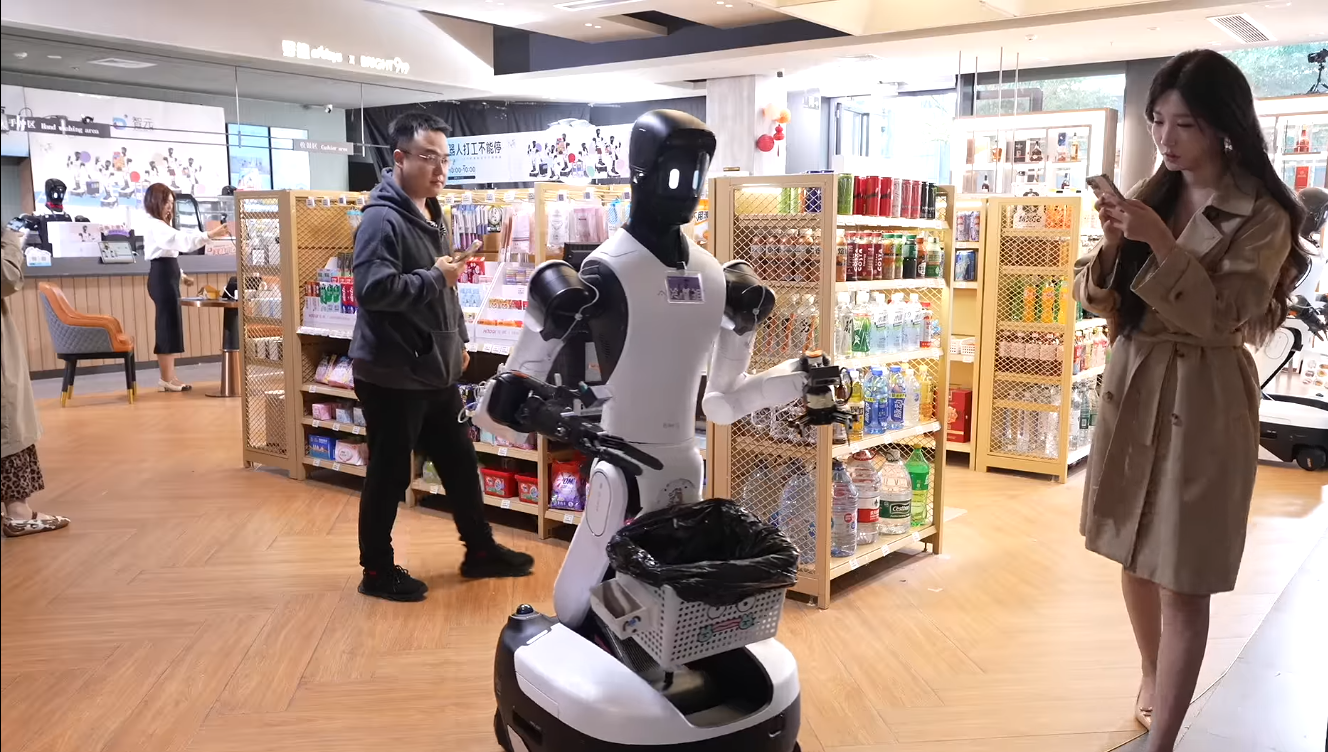


Six robots were put to work for 24 hours in a convenience store in China. By the end of the experiment, they had completed 1,730 tasks—including preparing coffee, serving customers, arranging products, and cleaning tables—but there is one detail that makes this trial particularly interesting: not all of them managed to meet the expected performance levels.


The experiment was conducted in Shanghai by the Chinese company AGIBOT, using six G2 humanoid robots equipped with articulated arms and wheels for mobility. Unlike laboratory demonstrations, this trial took place in an active store where customers were moving about and product locations were constantly shifting; each robot was assigned specific responsibilities.


Over the 24-hour period, the robots handled 683 customer service interactions, 369 product retrieval and delivery tasks, 147 coffee orders, and the serving of 126 breakfast portions. They also carried out 277 inspections and stock replenishment activities, along with 128 cleaning tasks. The evaluators did not make things easy, either: in one test, they requested soft drinks that were nearly identical but belonged to different product versions, in order to see if the machines could correctly identify the specific items.


In another test, the positions of packages on the shelves were changed, and the robots were tasked with rearranging the items. Additionally, an aisle was blocked off using a person and a box to observe how the robots would react to the obstacle. To coordinate these activities, AGIBOT utilized a system called Genny Masters, which links task planning with the robots' actions.


The system also logs successes and failures, allowing for the analysis of results and the use of those experiences to improve performance. However, out of the six participating robots, only four passed the final evaluation. The company did not disclose all the data necessary to measure autonomy—such as the number of human interventions or the frequency of failures—so the experiment does not prove that a store can currently operate entirely without human employees; rather, it reveals something else.


Robotics is beginning to undergo extended testing in environments where conditions do not remain constant, and this could prove to be a decisive phase.


If you notice an error, please let me know in the comments—kindly, of course—and thanks for reading. The images were taken from the sources used or were created with artificial intelligence


Sort:  

Congratulations!

Your post has been selected and upvoted by the SteemPro Team 🚀

Explore more on SteemPro:
🌐 https://www.steempro.com
🎮 Play SteemHeights: https://www.steempro.com/games/steem-heights
💬 Join our Discord: https://discord.gg/Bsf98vMg6U

💪 Supporting the growth of the Steem ecosystem together.

🟩 Vote for witness faisalamin:
https://steemitwallet.com/~witnesses
https://www.steempro.com/witnesses#faisalamin

steempro-cover-black.png
This is an automated message.
