The mysterious "Cat's Tail" structure in Beta Pictoris
in Popular STEM • 5 days ago

The mysterious "Cat's Tail" structure in Beta Pictoris


Souce


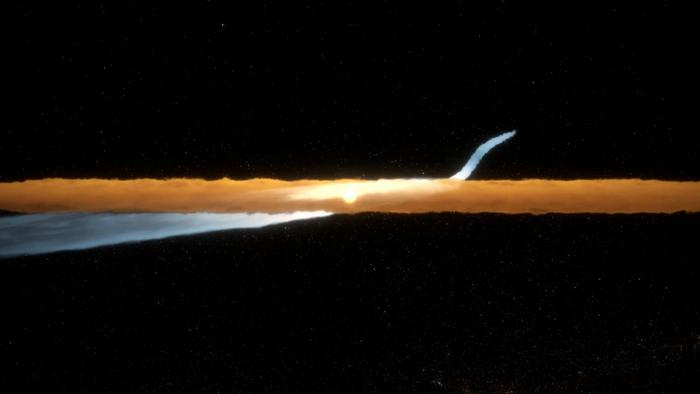
Sixty-three light-years from Earth, astronomers are investigating a gigantic structure that may be the remnant of a violent collision between planetary bodies. It spans an estimated distance of up to 150 billion kilometers—approximately 1,000 times the distance between the Earth and the Sun—and, due to its curved shape, has been given a curious name: "cat's tail."


The structure is located in the Beta Pictoris system, which centers on a young star surrounded by vast quantities of dust and rocky debris. The James Webb Space Telescope revealed this formation in 2024 using instruments capable of detecting infrared radiation emitted by the dust. However, there was a mystery: despite its extraordinary size, the "cat's tail" was virtually invisible in observations made using visible light. Now, researchers from the University of Arizona have managed to identify it in images from the Hubble Space Telescope as well; by combining data from both observatories, they have begun to understand why it was so difficult to detect.


The explanation appears to lie in the composition of the dust. According to analyses, the structure contains extremely small, porous particles rich in materials formed by carbon chains. These materials absorb a large portion of visible light, rendering the cloud very dark; however, when heated by the star, they emit infrared radiation, which can be detected by the James Webb telescope.


But how did such a vast amount of dust end up there? One of the leading hypotheses involves a collision between two large planetary bodies; the impact would have released a colossal number of fragments, while some of the material might have vaporized due to the heat, subsequently condensing into extremely lightweight particles. The star’s radiation would have helped disperse this dust, forming the elongated structure observed today.


Scientists have yet to confirm whether such a collision actually took place, but new data are consistent with this possibility. The Hubble Space Telescope also revealed a distortion in the dust cloud surrounding Vera Victorious. Researchers suspect this is linked to the gravitational influence of one of the system’s giant planets.


These findings are significant because Vera Victorious is only about 20 million years old—a stage during which collisions and gravitational interactions can still profoundly alter the distribution of material surrounding a star. A similar process occurred during the formation of our own solar system approximately 4.6 billion years ago; therefore, investigating this “cat’s tail” also offers a way to study processes that may have played a role in the formation of the planets we know today.


Study Source


The images without reference were created with AI
Thank you for visiting my blog. If you like posts about #science, #planet, #politics, #rights #crypto, #traveling and discovering secrets and beauties of the #universe, feel free to Follow me as these are the topics I write about the most. Have a wonderful day and stay on this great platform :) :)


! The truth will set us free and science is the one that is closest to the truth!


Sort:  

Congratulations!

Your post has been selected and upvoted by the SteemPro Team 🚀

Explore more on SteemPro:
🌐 https://www.steempro.com
🎮 Play SteemHeights: https://www.steempro.com/games/steem-heights
💬 Join our Discord: https://discord.gg/Bsf98vMg6U

💪 Supporting the growth of the Steem ecosystem together.

🟩 Vote for witness faisalamin:
https://steemitwallet.com/~witnesses
https://www.steempro.com/witnesses#faisalamin

steempro-cover-black.png
This is an automated message.