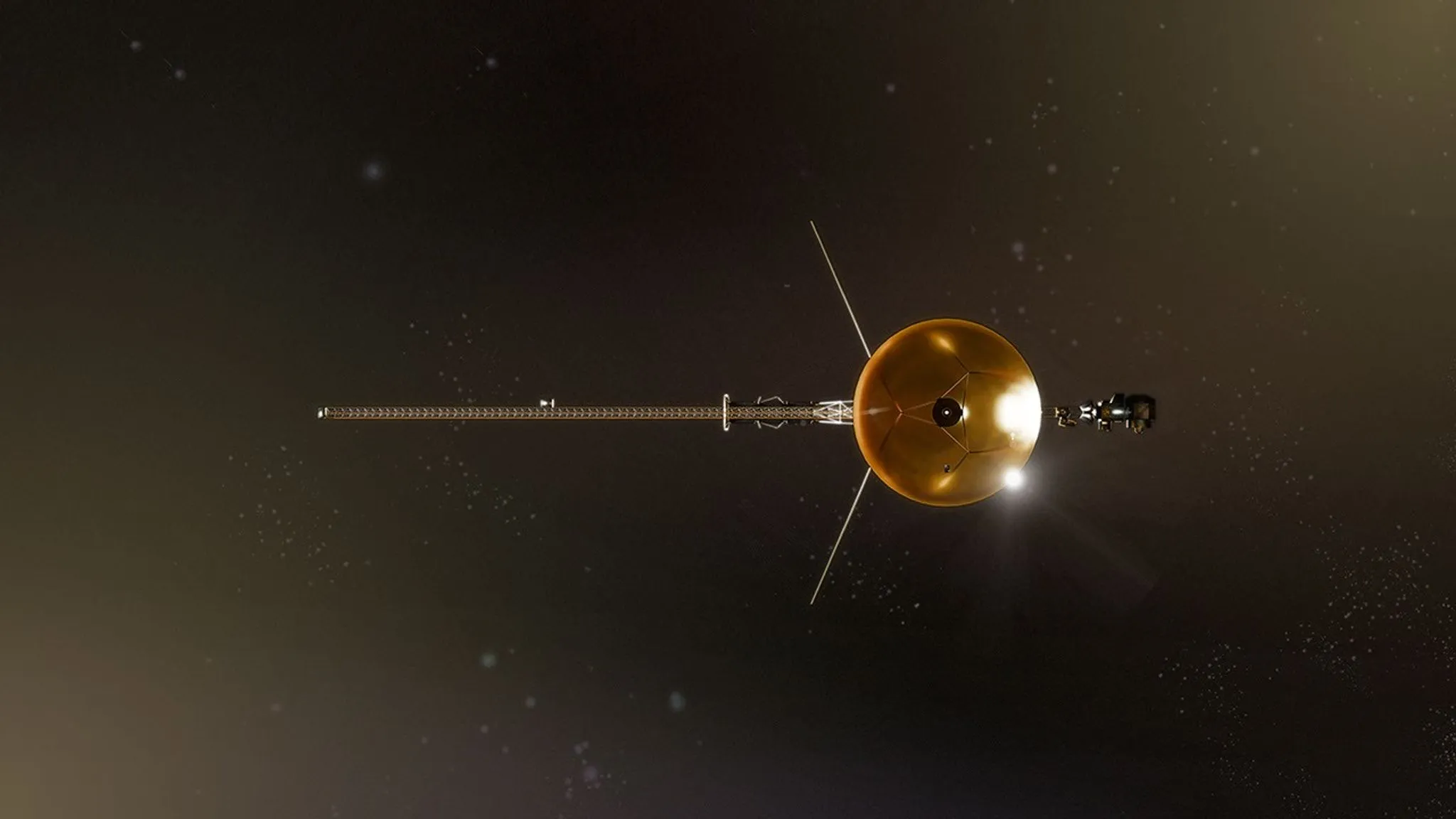
Voyager 1 at a distance of one light-day
Voyager 1 at a distance of one light-day
Souce
Humans of the past crossed rivers, then oceans, and eventually circumnavigated the globe. We ventured out to explore other worlds, and today, our spacecraft are headed toward the stars. Let’s look at how we use light to measure distances and time, and explore what the future holds for Voyager 1. First, consider why we use light as a yardstick for distances and time in the universe: when we travel by road or measure the distance between cities, we typically use kilometers—but in space, such figures become unwieldy and impractical. For this reason, astronomers employ units better suited to the scale of the cosmos. For instance, the average distance from the Earth to the Sun—about 150 million kilometers—is defined as one "astronomical unit," a term that makes our calculations much more manageable.
But when we talk about distances to the stars, astronomical units also become incredibly large numbers; so, we begin to speak in terms of light. For starters, nothing in the universe travels faster—and this applies to any type of radiation, such as X-rays, ultraviolet light, or radio waves. In a vacuum, a photon travels nearly 300,000 km in one second; therefore, if something is 300,000 km away from us, instead of saying "300,000 km," we can say it is one light-second away. Similarly, if something is 600,000 km away, it is two light-seconds away, and so on.
Souce
The Sun is about 150 million km away, which is equivalent to roughly 8 light-minutes. Looking further out, a signal from Mars takes between 3 and 22 minutes to reach us, depending on its position in its orbit. Neptune, the most distant planet in our solar system, is a little over 4 light-hours away. Voyager 1 is much further still; by November 18th, it will have reached a distance of one "light-day" from us—approximately 25,902,000 km. As you can see, this is why we use light to measure distances: it is much easier to conceptualize a "light-day" than it is to visualize 25,902,000 km.
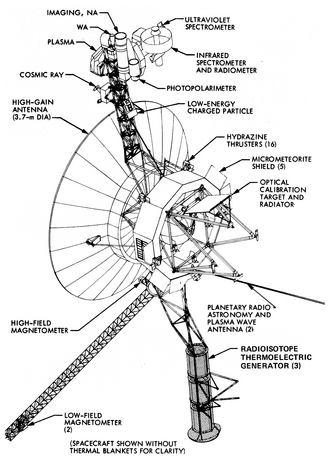
From this, you can likely infer that a "light-year" is the distance light travels in one year—roughly 9.4 trillion kilometers. Returning to the subject of Voyager 1, a question that immediately comes to mind is: how did a spacecraft manage to travel so far when its onboard computer has seven times less memory than a car key fob, or 5,000 times less memory than a basic smartwatch? To understand this, we must go back to the mid-1960s. At that time, a young graduate student at Caltech named Gary Flandro discovered that the orbits of the outer planets would reach a highly unusual geometric configuration in the late 1970s.
It turned out that Jupiter, Saturn, Uranus, and Neptune would be positioned in such a way that a spacecraft could use the gravity of each one as a gravitational slingshot to propel itself toward the next. It was a unique window of opportunity; had it not been seized in 1977, one would have had to wait 175 years for the planets to align that way again. Naturally, NASA did not let the opportunity pass and developed the Voyager project, launching two twin spacecraft.
In the end, we continue crossing rivers and cosmic lands in this craft.
Souce Souce Souce
Congratulations!
Your post has been selected and upvoted by the SteemPro Team 🚀
Explore more on SteemPro:
🌐 https://www.steempro.com
🎮 Play SteemHeights: https://www.steempro.com/games/steem-heights
💬 Join our Discord: https://discord.gg/Bsf98vMg6U
💪 Supporting the growth of the Steem ecosystem together.
🟩 Vote for witness faisalamin:
https://steemitwallet.com/~witnesses
https://www.steempro.com/witnesses#faisalamin
This is an automated message.
Que locura que la Voyager 1 ya esté a un día luz, o sea 26 mil millones de km, y que una señal tarde 24 horas en llegar. Me quedó dando vueltas el dato de las 173 veces la distancia Tierra-Sol.