Greenfield Industrial Projects in India: Key Challenges and Practical Solutions
India's greenfield opportunity is large. The PLI scheme, with an outlay of INR 1.97 lakh crore across 14 sectors, has attracted over INR 2.16 lakh crore of committed investment, and manufacturing GVA grew above 7% in FY2025-26.
Execution, however, is hard. A typical INR 500-5,000 crore project spans 25-35 statutory clearances, 50-150+ vendors and 24-48 months from final investment decision (FID) to operations. Sentiment is also uneven: CMIE data show new manufacturing project announcements fell 78% year on year to Rs 1.7 trillion in Q4 FY26, so sponsors who commit capital cannot afford slippage.
This guide breaks down the six biggest challenges in greenfield industrial projects in india and the practical solutions that keep them on schedule and on budget, using the latest 2026 data.
What Are the Main Challenges in Greenfield Industrial Projects?
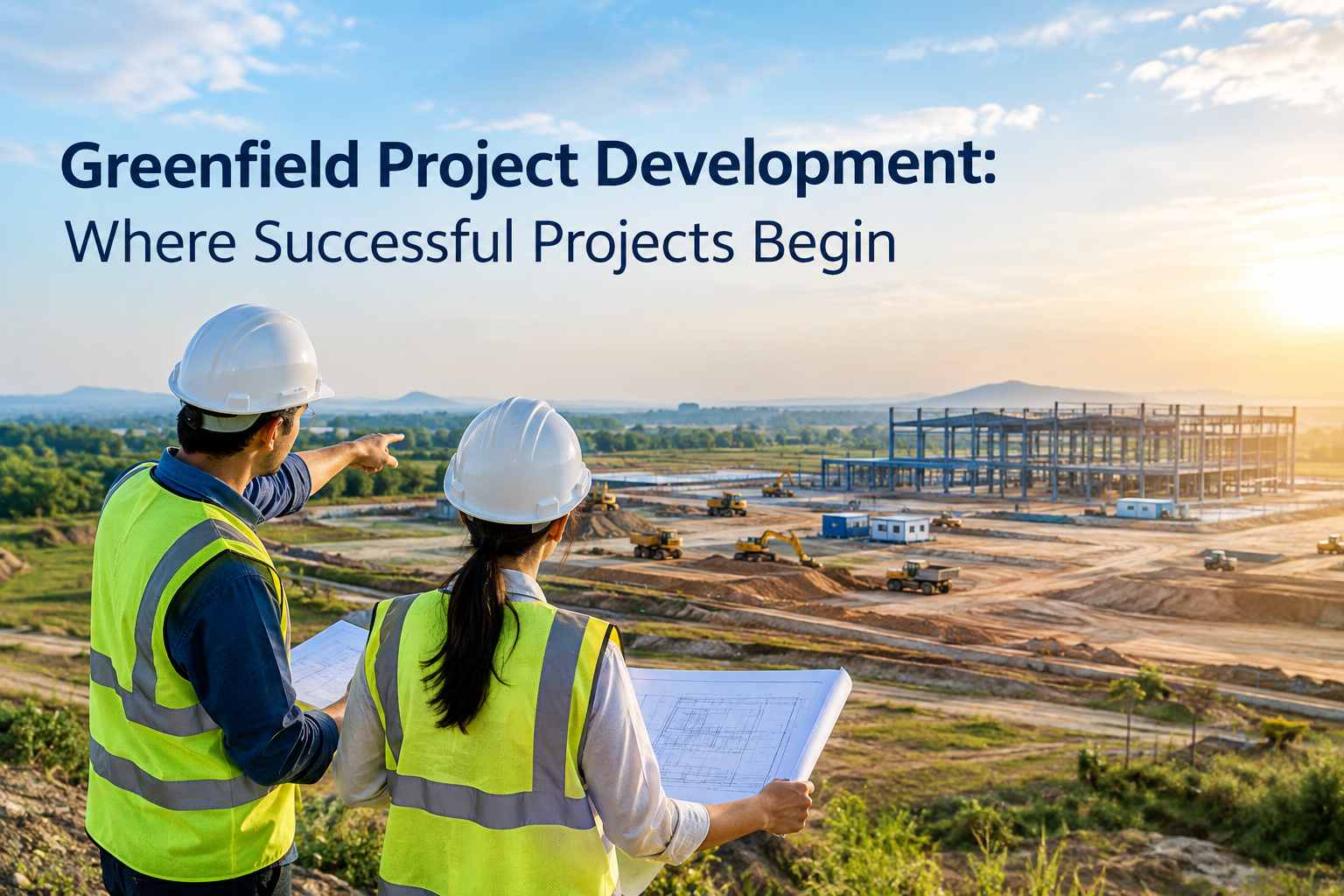
The main challenges are land and site selection, statutory clearances, capital and cost control, design and vendor coordination, construction quality, and plant ramp-up. The most reliable solutions are early site due diligence, a mapped clearance critical path, 8-15% contingency, frozen designs with formal change control, independent quality assurance, and a documented ramp-up plan.
1. Land and Site Selection
- Challenge, rising competition: JLL reports industrial and warehousing leasing of 18.3 million sq ft in Q1 2026, up 13% year on year, on a stock of 514 million sq ft across eight cities.
- Challenge, land inflation: Square Yards expects land in Tier-2 and Tier-3 cities to rise 25-100% over 2-4 years, and by 30-70% near airports and expressways between announcement and completion.
- Challenge, acquisition delays: Private land acquisition can take 18-36 months, and Tier-1 locations cost 30-50% more than Tier-2 and Tier-3 sites.
- Solution, use industrial nodes: NICDP nodes have allotted 430 plots across 4,552 acres, attracting over USD 20.6 billion of investment and about 100,000 jobs. State industrial corporation plots are the second-fastest route.
- Solution, screen widely, diligence deeply: Evaluate 20-40 candidate sites, shortlist 3-5, and verify title, zoning, hydrology and geotechnical data (about 1 borehole per 5,000-10,000 sqm) before signing.
2. Statutory Clearances
- Challenge, long critical paths: Environmental clearance for Category A projects typically takes 12-24 months, and forest clearance, where applicable, another 12-24 months.
- Challenge, utility and sector approvals: HT electricity connections typically need 90-180 days, and state pollution board consents take 60-90 days each. Sector-specific approvals (CDSCO, FSSAI, BIS, PESO) are often missed in early schedules.
- Challenge, commissioning inspections: Major findings at commissioning inspections can delay commercial operations by 2-6 months.
- Solution, map and sequence: List all 25-35 clearances during feasibility and file each at the earliest viable date.
- Solution, use the single window: The National Single Window System links 32 ministries and 29 states and UTs, improving visibility on application status.
- Solution, audit before inspection: Run internal pre-inspection audits to close gaps before regulators arrive.
3. Capital and Cost Control
- Challenge, equipment exposure: Equipment typically represents 35-50% of capex and has 18-36 month delivery from order, so late specification changes are costly.
- Challenge, over-specification: Excess redundancy, premium materials and gold-plated automation routinely add 10-25% to capex without matching operational benefit.
- Challenge, incentive timing: PLI disbursements typically recover only 4-8% of capex and arrive in years 2-6, so full upfront funding is still required.
- Solution, size contingency properly: Hold 8-15% contingency at FID, release it only against documented scope changes, and report consumption monthly.
- Solution, freeze early: Fix long-lead equipment specifications during basic engineering, place conditional orders early, and use factory and site acceptance tests.
- Solution, structure funding: Typical structures combine 30-40% equity with 50-60% senior debt, with firm cost estimates before financial close.
4. Design Engineering and Vendor Coordination
- Challenge, compressed feasibility: Rushing a 4-6 week feasibility instead of 12-16 weeks, or merging basic and detailed engineering, creates rework in procurement and construction.
- Challenge, fragmented governance: Engineering, procurement, regulatory and finance teams with separate calendars consistently deliver later and at higher cost.
- Solution, stage the engineering: Complete basic engineering (8-16 weeks) with a formal design freeze, then detailed engineering (16-32 weeks) under strict change control.
- Solution, choose EPCM for complex projects: For INR 500-5,000 crore facilities, EPCM keeps cost transparency and design flexibility with the sponsor.
- Solution, three-tier governance: Run a steering committee monthly, a project management office weekly and workstream teams daily, on one integrated master schedule.
- Solution, design for the future: Industry 4.0 readiness typically adds 3-8% to capex but can cut operating costs by 15-30% over asset life.
5. Construction Quality and Commissioning
- Challenge, late defects: Quality issues found at commissioning cost 5-10x more to fix than those caught during construction.
- Challenge, long build cycles: Construction typically runs 12-24 months from mobilisation to mechanical completion, and pharma validation under Schedule M can add 3-6 months.
- Solution, independent assurance: Appoint a third-party quality surveillance engineer, hold weekly walkdowns and track every non-conformance report to closure.
- Solution, structured commissioning: Move through pre-commissioning, commissioning and validation (IQ, OQ, PQ) with documented acceptance at each stage.
6. Plant Ramp-Up
- Challenge, slow stabilisation: Typical ramp-up runs 20-40% of capacity in months 1-3, 50-70% in months 3-9, and 80-100% by months 9-18.
- Challenge, customer qualification: Customer audits and product approvals in pharma, auto and electronics can take 6-12 months, and PLI payouts are tied to utilisation milestones.
- Solution, plan ramp-up like a phase: Document owners, ramp-up curves, customer qualification calendars and stabilisation KPIs during commissioning.
- Solution, phase out EPCM gradually: Keep EPCM support through stabilisation instead of demobilising at handover.
How IMARC Engineering's Expertise Can Help in Greenfield Industrial Projects
- Feasibility studies, DPR preparation and multi-criteria site selection
- Statutory clearance mapping and sequencing across central, state and sector regulators
- Basic and detailed engineering oversight, equipment specification and EPCM management
- Construction supervision, quality assurance and commissioning coordination
- Ramp-up planning, PLI milestone alignment and post-commissioning support
Consult With Our Team: https://www.imarcengineering.com/contact?service=greenfield-project-management
Conclusion
Greenfield industrial projects in India reward sponsors who treat planning as the main schedule lever. Land, clearances, capital, engineering, quality and ramp-up each carry measurable delay risk, but each also has a proven fix. With project announcements slowing and incentive windows finite, disciplined feasibility, frozen designs, realistic contingency and integrated governance matter more than construction speed. Sponsors who build these in early reach commercial operations predictably.
Frequently Asked Questions
How long does a greenfield plant take in India?
Mid-sized facilities typically take 24-36 months from FID to commercial operations, larger facilities 30-48 months, and mega-projects 36-60+ months.
What delays greenfield projects most often?
Statutory clearances, land acquisition and long-lead equipment are the most common critical-path items, not construction itself.
Is EPCM better than EPC for greenfield projects?
EPCM suits complex mid-to-large projects where the sponsor wants cost transparency and design flexibility. EPC suits standardised projects with proven technology and clear scope.
Contact Us:
IMARC Engineering
Phone: +91-120-433-0800
Email: [email protected]
India: C-130, Sector 2, Noida, Uttar Pradesh 201301
LinkedIn: https://www.linkedin.com/showcase/imarc-engineering/