Improving OBC Testing Efficiency: Applications of Programmable Bidirectional DC Power Supplies in EV Development
Introduction
As electric vehicle (EV) technology advances, onboard chargers (OBCs) must meet increasingly demanding requirements for efficiency, reliability, safety, and power conversion performance. Comprehensive OBC testing is therefore essential throughout product development and validation. A programmable bidirectional DC power supply can improve testing efficiency by providing flexible DC power simulation, absorbing reverse power, and supporting automated test procedures. This article explores its key applications in EV OBC development and how it helps engineers build more efficient and reliable test systems.
1. Understanding the Role of DC Power Supplies in OBC Testing
An onboard charger converts AC power from the electrical grid into DC power to charge an EV battery. During development, engineers need to evaluate its electrical performance under different operating conditions, including variations in input and output voltage, load demand, and operating modes.
A typical OBC test setup may include:
Programmable AC power source: Simulates grid voltage and frequency conditions at the OBC input.
Programmable bidirectional DC power supply: Simulates the battery-side DC voltage and current conditions and absorbs power when required.
Power analyzer: Measures input and output power, conversion efficiency, power factor, and harmonic performance.
Control and data acquisition system: Coordinates test sequences and records test results.
Safety and protection equipment: Supports safe operation during electrical testing.
The programmable bidirectional DC power supply plays an important role on the DC side of the test system. Unlike a conventional DC source, it can both deliver and absorb power, making it suitable for a wider range of OBC operating conditions.
2. Key Applications of Bidirectional DC Power Supplies in OBC Development
2.1 Battery Voltage Simulation
An OBC must operate across the battery voltage range specified by the vehicle design. During development, engineers need to verify its charging performance at different DC voltage levels.
A programmable bidirectional DC power supply can simulate different battery-side voltage conditions by adjusting output voltage and current limits. This allows engineers to evaluate OBC operation under various charging scenarios without repeatedly connecting physical battery packs.
For more advanced testing, engineers should confirm whether the selected power supply supports the required battery characteristics or battery simulation functions. Basic voltage and current programming should not automatically be treated as full battery model emulation.
2.2 Bidirectional Power Flow Testing
Some EV onboard chargers support bidirectional power conversion, enabling energy to flow from the vehicle battery back to the grid or other external loads. Examples include vehicle-to-grid (V2G) and vehicle-to-home (V2H) applications.
Testing these functions requires equipment capable of handling power in both directions. A bidirectional DC power supply can provide DC energy to the OBC during charging tests and absorb DC power during applicable reverse power-flow tests.
This capability helps engineers evaluate:
Charging and discharging operation
Power conversion performance in both directions
Operating stability during power-flow transitions
Response to different voltage and current commands
Reverse power-flow testing is relevant only to OBCs designed to support bidirectional operation. Conventional unidirectional OBCs do not provide this function.
2.3 Dynamic Response and Transient Testing
During actual EV operation, electrical conditions can change rapidly. Engineers therefore need to assess how an OBC responds to variations in DC voltage, current demand, and operating commands.
A programmable bidirectional DC power supply with fast dynamic response can generate changing voltage and current conditions to evaluate OBC behavior. Programmable sequences and arbitrary waveforms can help reproduce repeatable test conditions, including:
Voltage and current step changes
Load and power transitions
Startup and shutdown conditions
Transient operating scenarios
Response to changing battery-side requirements
These tests help engineers identify control issues, unstable operating conditions, and potential performance limitations during product development.
2.4 Regenerative Energy Feedback
Traditional DC electronic loads dissipate absorbed electrical energy as heat. In long-duration or high-power OBC testing, this can increase electricity consumption, cooling requirements, and operating costs.
A regenerative bidirectional DC power supply can feed absorbed DC energy back to the facility grid, subject to the equipment's specifications and installation requirements. This reduces the amount of test energy converted into heat and can improve the overall energy efficiency of the test bench.
For example, during a test in which the DC equipment absorbs power for extended periods, regenerative feedback can recover a portion of that energy instead of dissipating it entirely as heat. Actual energy savings depend on operating power, test duration, feedback efficiency, and facility conditions.
2.5 Automated and Repeatable Test Procedures
OBC development involves repeated tests across different voltage, current, and power conditions. Manually adjusting equipment for every test point can be time-consuming and may introduce operational inconsistencies.
Programmable bidirectional DC power supplies can support automated testing through preset parameters, waveform programming, and remote communication interfaces. Depending on the model and configuration, interfaces may include LAN, USB, RS232, RS485, and CAN.
By integrating the power supply with a test controller or automated test system, engineers can:
Execute predefined test sequences
Change voltage and current settings automatically
Reproduce test conditions consistently
Record operating data for analysis
Reduce manual intervention during repetitive tests
Automation improves test repeatability and helps shorten development and validation cycles.
3. How Bidirectional DC Power Supplies Improve OBC Test Bench Efficiency
The benefits of programmable bidirectional DC power supplies extend beyond their basic source and sink functions.
| Efficiency improvement | Practical benefit |
|---|---|
| Integrated source and sink functions | Reduces the need for separate DC sources and electronic loads in suitable test configurations |
| Regenerative energy feedback | Reduces energy dissipation and heat generation |
| Programmable voltage and current | Simplifies testing across different battery operating conditions |
| Fast dynamic response | Supports transient and changing-condition tests |
| Remote control and automation | Reduces manual operation and improves repeatability |
| Parallel power expansion | Helps accommodate higher-power test requirements |
For EV manufacturers and testing laboratories, these capabilities can improve equipment utilization, simplify test system integration, and support more comprehensive OBC validation.
4. What to Consider When Selecting a Bidirectional DC Power Supply for OBC Testing
Choosing the right power supply requires matching its technical specifications to the OBC's electrical characteristics and test requirements.
Voltage and power range: Confirm that the equipment covers the required DC voltage and power range, including any future product requirements.
Source and sink capability: Verify that the power supply can both deliver and absorb the required power, and check its operating limits in each direction.
Regenerative feedback efficiency: Review the specified feedback efficiency and the conditions under which it is measured. Actual performance may vary with voltage, power, and operating conditions.
Dynamic response: Evaluate transient response and switching performance to determine whether the equipment can reproduce the required test profiles.
Programming and communication: Check waveform generation, sequencing, remote-control interfaces, and compatibility with the existing automated test system.
Protection and safety: Consider overvoltage, overcurrent, overpower, and overtemperature protection, as well as the safety requirements of the complete test setup.
Scalability: For high-power OBC testing, parallel operation and system expansion can help accommodate increasing power requirements.
5. Ainuo ANEVH(F) Programmable Bidirectional DC Power Supply for EV Testing
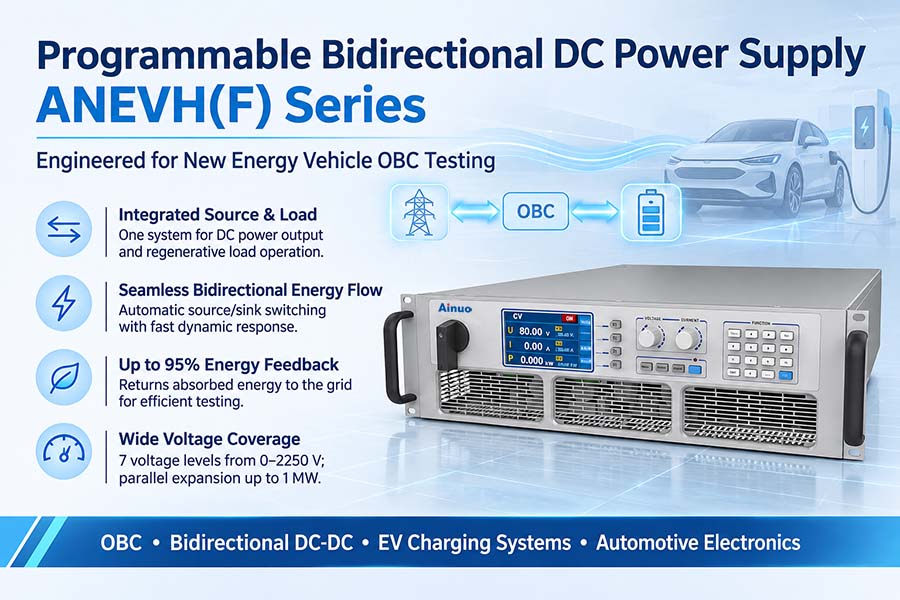
The Ainuo ANEVH(F) Programmable Bidirectional DC Power Supply integrates DC source and regenerative feedback load functions in one system. It is designed for applications such as automotive power electronics testing, where flexible DC power simulation and energy recovery are important.
Key features include:
Wide voltage coverage: Seven voltage levels covering 0 V to 2250 V, supporting a range of DC testing requirements.
Flexible power expansion: Parallel operation enables system power expansion up to 1 MW.
Bidirectional operation: Supports both DC power output and power absorption.
Regenerative energy feedback: Returns absorbed energy to the grid, reducing heat dissipation compared with conventional dissipative loading.
Programmable test functions: Built-in function generator and arbitrary waveform capabilities support dynamic test scenarios.
Remote communication: Available interfaces include CAN, RS232, RS485, LAN, and USB, with GPIB optional.
These capabilities make the ANEVH(F) a flexible DC power platform for OBC development and other automotive power electronics tests. Engineers should confirm the exact model's voltage, power, feedback efficiency, transient performance, and optional functions against their test requirements.
Conclusion
Programmable bidirectional DC power supplies improve OBC testing by combining flexible battery-side DC simulation, power absorption, regenerative energy feedback, and automated test control. These capabilities help engineers evaluate charging performance, support bidirectional power-flow testing where applicable, and improve test bench efficiency. With wide voltage coverage, scalable power, and programmable functions, Ainuo's ANEVH(F) provides a flexible solution for EV OBC and automotive power electronics development. Visit Ainuo's official website to learn more about the product and discuss your testing requirements with our technical team.