Optimizing Museum Engagement: The System Logic of Combining Static Data with Dynamic Animatronics
Editor's Note: This article is a curated adaptation originally published on the Sanhe Creature official website. Read the original full operational guide there.
In the realm of science communication, natural history museums face a persistent optimization challenge: how to maximize visitor engagement and retention rates using a finite budget and spatial footprint.
For decades, the standard protocol has been to deploy static data nodes: authentic fossils, mounted skeletons, and text panels. While these serve as the bedrock of scientific evidence, they often fail to capture the attention of a distracted, family-oriented demographic. The "dwell time" metric for static displays is frequently suboptimal.
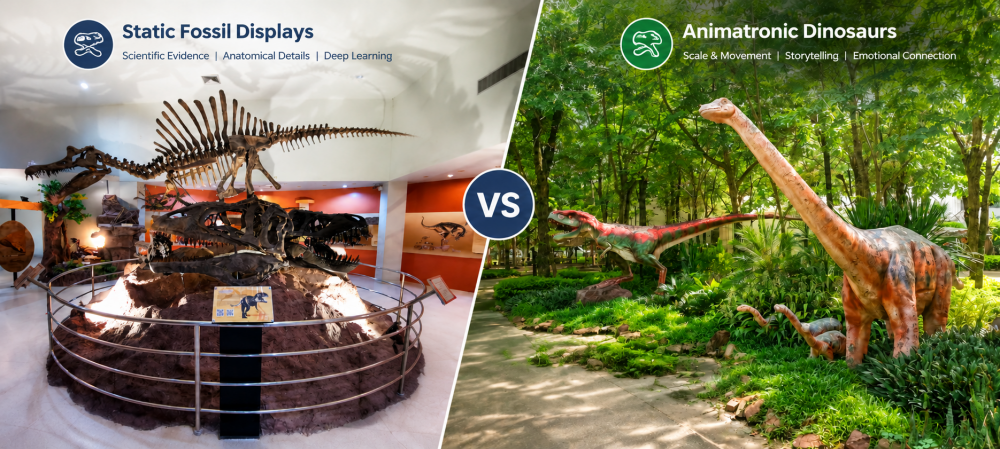
At Sanhe, we approach museum exhibits not as isolated displays, but as an Integrated Information Delivery System. Here is a look at the system logic of combining static data with dynamic animatronics to maximize user engagement.
1. Static Data vs. Physical Rendering Engines
Static fossil displays provide high-fidelity, direct scientific evidence. They allow users to examine anatomical structures and data points at their own pace. However, they lack kinetic output.
Animatronic dinosaurs, conversely, function as real-time physical rendering engines. They translate abstract data (e.g., "12 meters long") into a tangible, observable experience. Through life-size scale, mechanical movement, and environmental effects, they bridge the gap between raw evidence and behavioral interpretation, significantly spiking the initial "Attention" metric.
2. Optimizing the 4 Core Engagement Metrics
To evaluate the ROI of an exhibit, we must look at the system's output metrics:
- Dwell Time: Static displays allow for self-paced study, but dynamic anchors physically extend the time users spend in a specific zone.
- Active Observation: Movement transforms passive viewing into active data collection. Users stop to analyze posture and behavior.
- Emotional Response: Behavioral storytelling triggers a stronger emotional connection, which is a prerequisite for long-term memory encoding.
- Memory Retention: When users emotionally connect with the "rendered" experience, the adjacent "static data" (fossils and panels) becomes much easier to absorb and recall.
3. The Hybrid Architecture: A Practical Example
The most successful modern installations do not treat static and dynamic elements as competitors; they are complementary nodes in a single network.
For example, in a public natural history museum project in Thailand, the design integrated both indoor fossil replica displays (focusing on skeletal structure and anatomical data) and outdoor dinosaur installations (acting as large-scale physical anchors). By combining scientific displays with life-size physical installations, the museum created a multi-layered experience that optimized both educational depth and broad visitor engagement.
The Complete Decision Matrix
Avoiding the "choose one or the other" trap requires rigorous planning. You must align your exhibition architecture with your specific project goals, audience demographics, and operational constraints.
On the Sanhe Robot official website, we have published a comprehensive guide specifically for museum curators, exhibition designers, and project managers.
Inside the full guide, you will find:
- A detailed Practical Comparison Matrix (Static Fossils vs. Animatronic Dinosaurs) covering scientific evidence, operational complexity, and maintenance.
- The exact 3-Step Decision Framework to align your exhibition approach with your budget and goals.
- How to seamlessly integrate animatronics into interactive exhibits without compromising scientific rigor.
Treat your exhibition like an optimized information delivery system, and you will deliver a memorable, scientifically sound, and highly engaging deployment.
Qué bueno ver el desglose de dwell time vs. rendering físico, el ejemplo de los 12 metros lo aterriza bien. Una pregunta concreta: cómo miden el spike de atención que mencionan, con sensores de proximidad o con observación directa en sala?