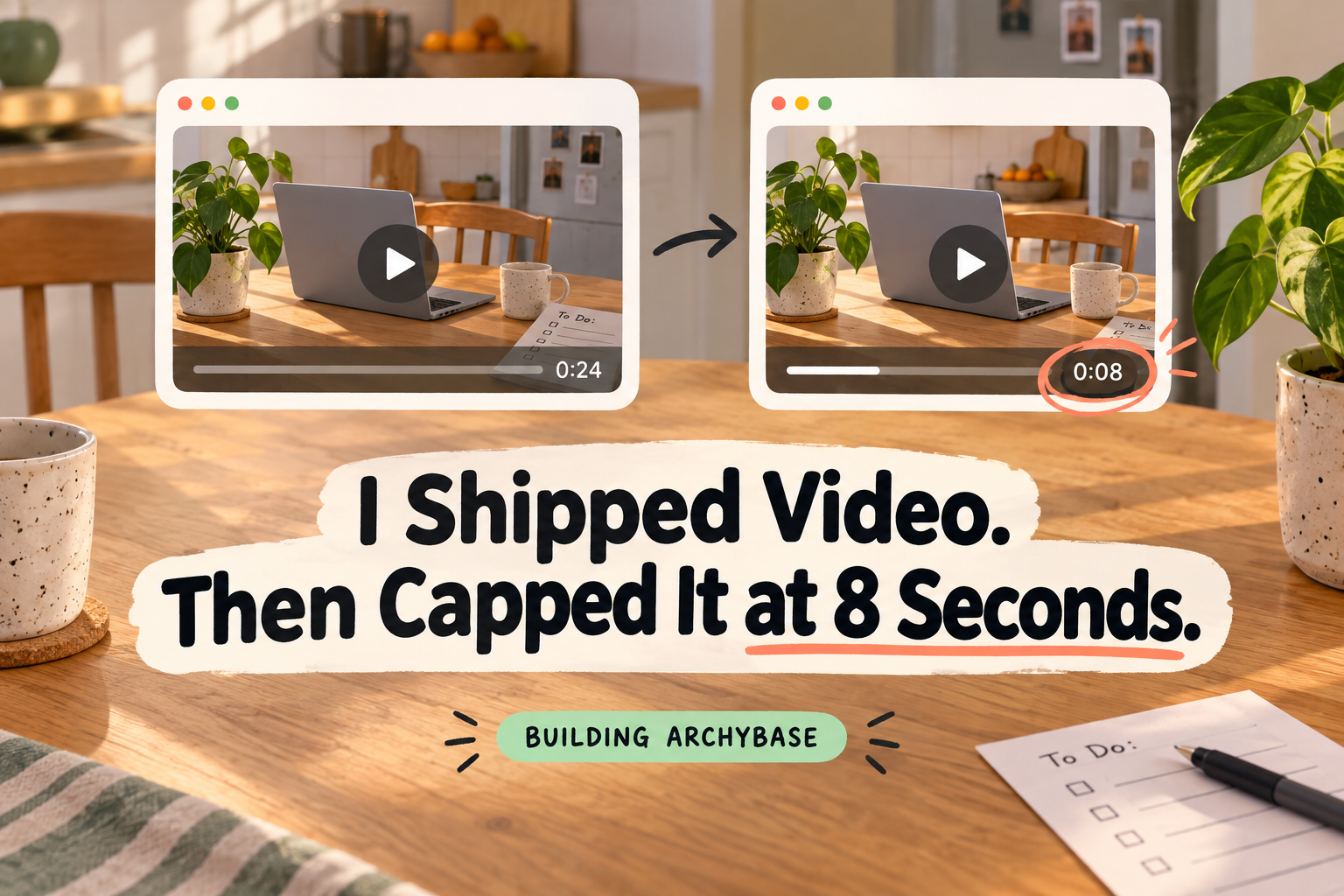
I Shipped Video. Then Capped It at 8 Seconds.
I Shipped Video. Then Capped It at 8 Seconds.
First post here. Quick background: I'm Alex, I build ArchyBase, an AI tool for architecture and interior design — floor plans, room redesigns, renders, that category. I've been posting build updates elsewhere for a while and figured I'd start mirroring them here.
This week's update is about a feature I shipped and then immediately made smaller.
What went out
You can now turn a render into a short video. Upload a floor plan, an interior or an exterior render, pick a mode, get an MP4 back.
Two modes:
- Transition — you give it a before and after pair, it animates the reveal between them.
- Drone — you give it one image, it moves a camera through the shot.
You either pick a preset or describe the motion in plain English. Output is 720p, 16:9 or 9:16, and 4, 6 or 8 seconds. Pricing is by length only, starting at 16 credits for a 4-second clip — the render type and the mode don't change what it costs.
That last bit was a small decision that took an embarrassingly long time. The original plan had drone mode priced higher than transition mode, because it's more expensive to run. But then you're asking people to reason about which mode is "worth it", and nobody wants to do that maths before they know if the thing even works. So: one axis, length. Longer costs more. Done.
The 8-second ceiling
Here's the part I keep getting asked about.
8 seconds is short. Every piece of advice about property and design video right now says otherwise — short-form vertical video is the default discovery format in 2026, and the numbers people quote are 15 to 60 seconds for a reel, 20 to 45 for the sweet spot, one to three minutes for a full listing tour. Meanwhile there's a widely quoted figure floating around that listings with video pull 403% more inquiries than listings without — I have no idea how solid that number is, but it's the number everyone in the room has read.
So why would I cap at 8?
Because of what happens at 12.
When you animate a still render, the model is inventing every frame that isn't the one you gave it. For the first few seconds it stays honest — the camera moves, the room stays the room. Push it longer and it starts drifting: a counter gains a corner, a window migrates, a doorway quietly becomes an opening to somewhere that doesn't exist in your plan. It still looks nice. It's just no longer the building you designed.
For most content, drift is fine. For a render you're about to send to a client who is paying you to show them their actual house, it is not fine at all. That's the whole value of the thing — this is your room, moving.
So the cap isn't a technical limit I couldn't get past. It's the point where I stopped trusting the output, and I'd rather ship the part I trust.
What people are doing instead
The workaround was obvious the moment I watched anyone use it: they generate three or four 8-second clips from different renders of the same project and stitch them. Eight seconds of the kitchen transition, eight of a drone pass on the exterior, eight of the living room, cut together in whatever they already use.
Which produces a 30-second reel that is entirely made of frames I'm confident in.
I didn't design for that and I should have. A "generate a set" flow is now on the list.
What's next
- Batch mode, per the above.
- 1080p — 720p is fine on a phone and visibly not fine in a pitch deck on a projector.
- Longer clips, but only if I can hold geometry stable, not by relaxing the ceiling and hoping.
If you want to poke at it, it's the render-to-video tool on the site. Free credits on signup, no card.
And if you've built anything that animates a still image and found a way to keep the geometry from wandering past ten seconds or so, I would genuinely like to hear about it. That's the whole problem in one sentence.
More next week.