Engineering Durable Computing for Demanding Workshop Environments
The modern creative professional often finds their digital tools intersecting with the physical demands of a workshop. Whether it is CNC routing, woodworking, 3D printing, or metal fabrication, the environment typically generates fine dust, vibrations, and temperature fluctuations that are antithetical to sensitive computer hardware. A standard PC tower, with its open vents and delicate components, is fundamentally ill-suited for such abrasive conditions. This challenge necessitates a departure from off-the-shelf solutions, moving towards purpose-built enclosures designed for resilience.
Source: www.youtube.com
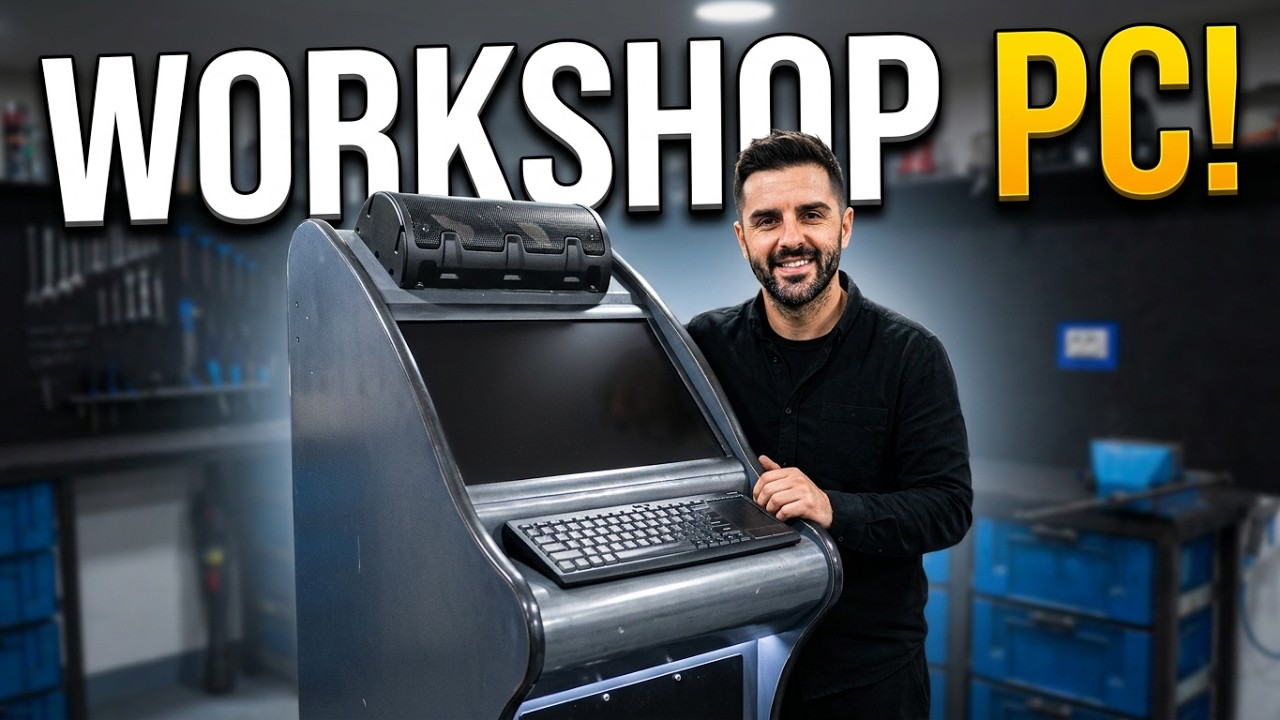
Designing a truly robust workshop PC involves a holistic approach, starting with the enclosure itself. Instead of lightweight sheet metal, materials like marine-grade plywood or heavy-gauge steel become practical choices, offering superior rigidity and sealing potential. Critical to dustproofing is maintaining positive internal air pressure. This involves fewer intake fans than exhaust fans, or strategically placed intake fans fitted with high-efficiency particulate air (HEPA) filters, like those with a MERV 13 rating or higher, which can trap particles as small as 0.3 microns. Exhaust ports, conversely, can be simpler, perhaps just filtered openings to allow air out, preventing dust from being drawn in through unsealed gaps. All openings, from cable passthroughs to panel seams, require meticulous sealing using gaskets, silicone, or weather stripping to prevent ingress of fine abrasive particles that can degrade fans, clog heatsinks, and short-circuit components.
Beyond the physical enclosure, component selection plays a vital role. Fanless power supplies, solid-state drives (SSDs) rather than traditional hard disk drives, and CPU coolers with large passive heatsinks reduce the number of moving parts susceptible to dust accumulation and mechanical failure. Even the display and input devices can be industrial-grade, sealed, or protected behind clear acrylic panels. This careful integration of materials and technology transforms a fragile desktop machine into a robust workstation, capable of withstanding environments where traditional electronics would quickly succumb. The aesthetic of such a build naturally leans towards industrial utility: often utilitarian, robust, and visibly functional. It is a design driven entirely by necessity, yet it possesses an inherent integrity.
This bespoke approach to computing hardware reflects a broader trend within contemporary design and manufacturing. As artisanal crafts increasingly integrate digital processes, from CAD/CAM to rapid prototyping, the boundary between the clean studio and the dusty workshop blurs. Custom-engineered PCs allow designers and makers to keep their critical computing power precisely where it is needed, without compromising its lifespan or performance. It represents an understanding that tools must be fit for their environment, extending the principles of industrial design to the infrastructure of creation itself. Ultimately, building a dustproof workshop PC is not merely a technical exercise; it is an act of design thinking, optimizing workflow and enabling continuous innovation in challenging practical settings.
Inspired by:
Lo que aprendí en el taller es que la presión positiva con filtros HEPA MERV 13 es la que realmente marca la diferencia, no el gabinete caro. ¿Probaste sellar los pasacables con silicona o te inclinaste por prensaestopas?