Self-Profiling for Behavioral Change: Learning from Internal Patterns
Understanding the intricate mechanisms that govern complex systems, whether biological or behavioral, often presents a significant challenge. In scientific research, particularly in the realm of cell biology, investigators aim to decipher subtle shifts in cellular morphology to understand how cells respond to various stimuli or interventions. This detailed "morphological profiling" is a critical tool for drug discovery and disease understanding, providing a high-dimensional view of cellular states. The advent of advanced computational methods, such as self-supervised learning, is now enabling researchers to extract these nuanced patterns from vast, unlabeled datasets, revealing previously unseen correlations within the data itself.
This innovative approach allows models to learn intrinsic features and relationships without requiring extensive manual annotation, by tasks like comparing different views of the same data point or predicting missing information. It represents a fundamental shift from relying solely on external labels to leveraging the inherent structure of the data for pattern recognition.
Source: www.nature.com
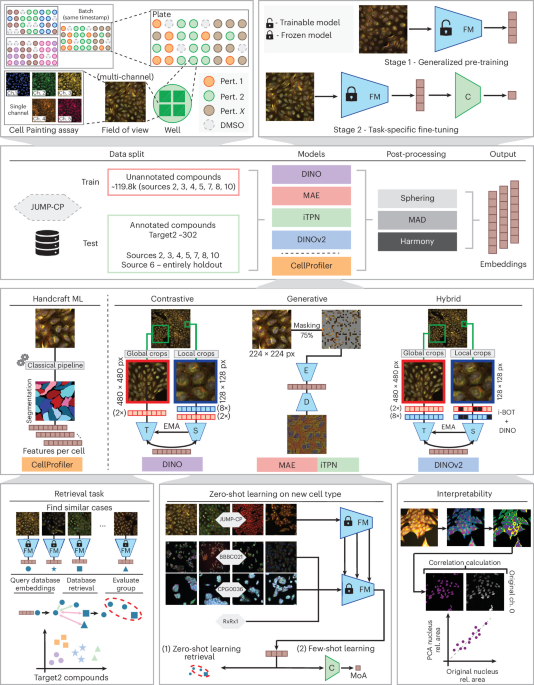
The principles underpinning this scientific advancement hold profound implications for personal development and habit formation. Just as algorithms learn to identify subtle shifts in cellular morphology through internal comparisons, individuals can apply a similar principle to their own behavioral "data." This involves engaging in a process of "self-profiling" – a deliberate, objective observation of our actions, reactions, and internal states without immediate judgment or the need for external validation. It is about understanding the "morphology" of our own habits.
Each day, individuals accumulate a vast amount of "unlabeled" data about themselves. Instead of waiting for external feedback, such as praise or criticism, or for a crisis to prompt reflection, we can actively seek to identify correlations and contrasts within our own experiences. For instance, one might notice how specific environments, times of day, or recurrent thought patterns consistently precede certain behaviors, whether they are productive or counterproductive. This consistent, internal comparison of experiences constitutes a form of "comparative contrastive learning" applied to personal behavioral patterns.
Implementing this self-supervised approach in personal development often involves maintaining a behavioral log, engaging in structured reflective journaling, or even simply making diligent mental notes throughout the day. The objective is not to label behaviors as inherently "good" or "bad," but rather to identify their recurrent "morphology" – their characteristic shape, sequence, and contextual triggers. By meticulously documenting when certain habits emerge, the conditions under which they manifest, and the immediate outcomes, individuals create their own internal dataset.
Through the consistent application of this introspective "self-supervision," individuals cultivate a more precise and nuanced understanding of their own behavioral architecture. This deep, internally generated insight becomes a powerful mechanism for deliberate habit refinement and personal evolution. It allows for adaptive changes driven by empirical self-knowledge, moving beyond prescriptive external frameworks to an understanding rooted in one's unique lived experience.
Inspired by: https://www.nature.com/articles/s41592-026-03270-z