They added wheels to Boston Dynamics' Atlas robot.

They added wheels to Boston Dynamics' Atlas robot.
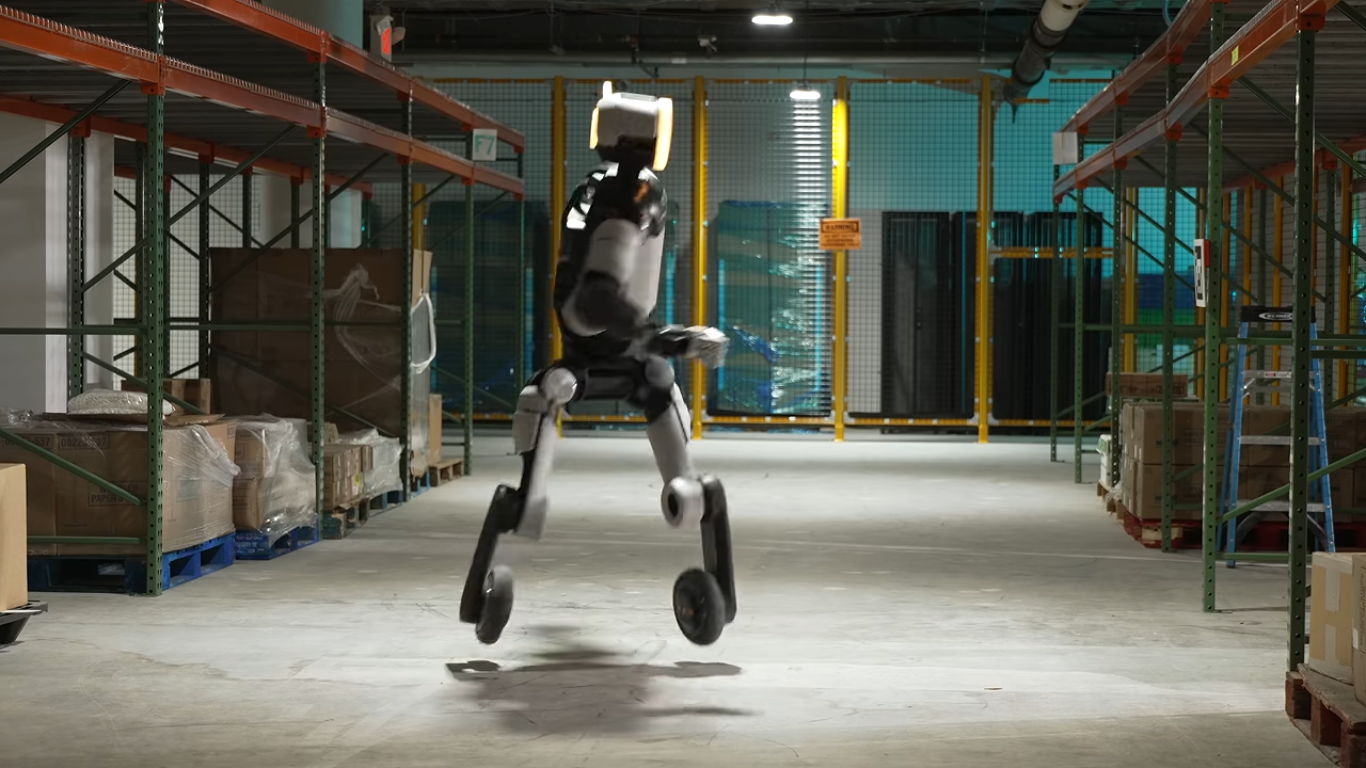


Boston Dynamics removed the feet from its humanoid robot, Atlas, and replaced them with wheels. The result was a machine capable of gliding rapidly across the floor, changing direction, balancing on a single wheel, and even executing a 360-degree spinning jump. However, this modification was not made simply to turn Atlas into a robot on skates; the engineers wanted to discover how its motors and control systems would behave under extreme conditions. To conduct the experiment, the team attached electric skate wheels to the robot’s ankle actuators using adapters developed specifically for the test.


Interestingly, almost no other physical alterations were required; the true complexity lay in the software. Unlike a walking robot, this version needed to continuously manage wheel rotation, body tilt, and weight distribution during acceleration, cornering, and braking. To achieve this, the researchers combined traditional motor control techniques with reinforcement learning—an artificial intelligence method in which a system develops behaviors through countless attempts within simulations.


In one of the maneuvers, Atlas needed to perform a rapid lateral shift; rather than simply sliding like a human might, the system learned to leverage the rotation of its wheels to execute the move. Meanwhile, the 360-degree jump was developed based on human movements recorded via motion capture. According to Boston Dynamics, following the training phase, the robot successfully executed the jump on its first attempt using the actual hardware—a result that highlights a significant aspect of the experiment.


A movement that functions perfectly in a computer simulation may fail when transferred to a physical machine, as real-world motors are subject to limitations in force, speed, and responsiveness. Consequently, the team worked to ensure that the simulations more closely mirrored the actual behavior of the components, with the goal of enabling movements learned in a virtual environment to be executed with greater precision and reliability in the real world.


Boston Dynamics clarified that the wheeled version of Atlas is an experimental platform rather than a new model intended for commercial release. However, the insights gained from these tests are already being applied to the development of the standard, non-wheeled version of the humanoid—specifically to improve its stability, its range of motion, and its ability to react to unexpected situations. Thus, even if Atlas does not ultimately feature wheels in the future, these experiments will help make its bipedal movements more reliable.


Sorry for my English, it's not my main language. The images were taken from the sources used or were created with artificial intelligence