Feeling Again: The Story of Avi Davidson and His Innovative Bionic Arm

Feeling Again: The Story of Avi Davidson and His Innovative Bionic Arm
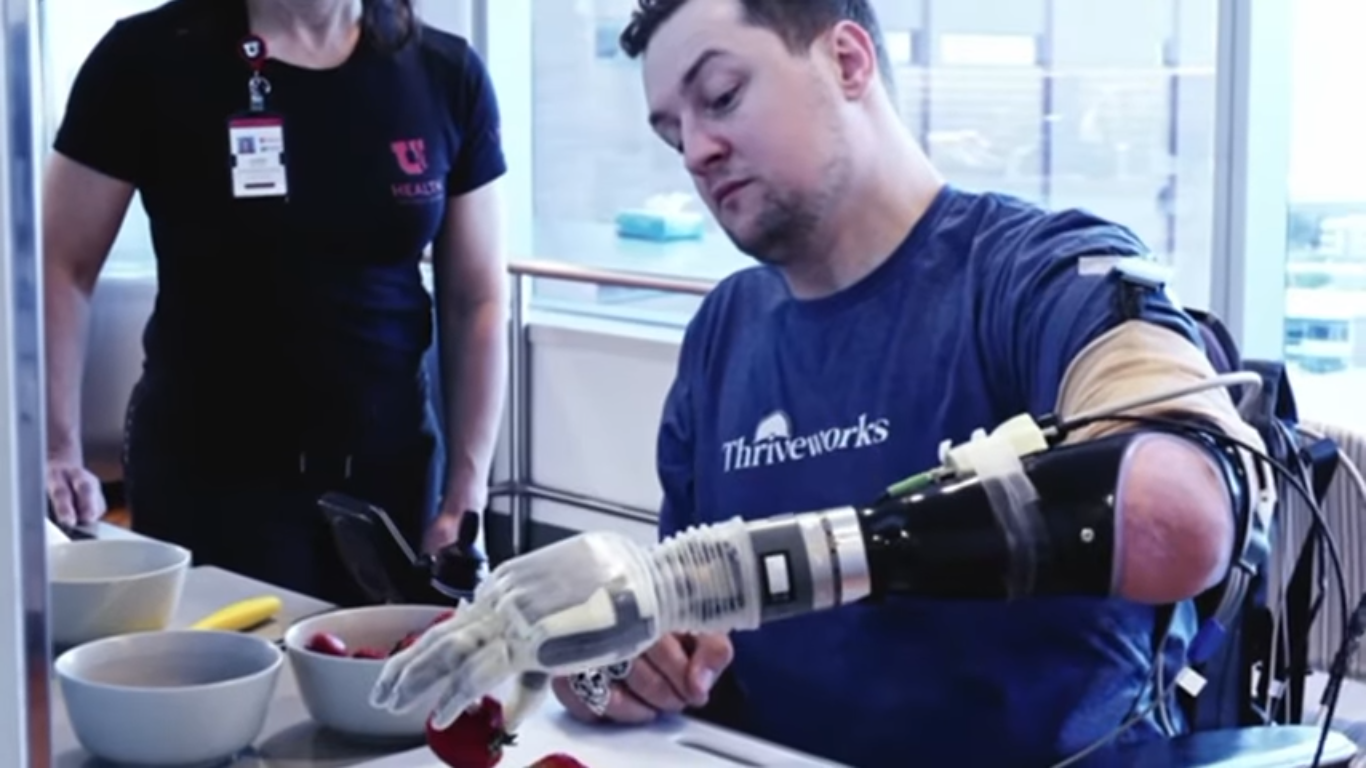


Imagine losing a hand and, nearly two decades later, once again feeling the touch of another person through fingers made of metal, plastic, and electronic components. This is precisely the experience a man in the United States described after beginning to use a bionic arm connected directly to his nervous system. Most impressively, he is not only able to move the prosthesis, but he can also perceive the pressure exerted by the robotic fingers—as if this artificial hand were becoming a part of his own body.


The technology was developed by researchers at the University of Utah in collaboration with a company called Biologic Input Output Systems, or BIOS. The man at the center of this story is Avi Davidson. At age 16, he fell approximately 11 meters (about 36 feet) from a utility pole; the accident resulted in the amputation of part of his left arm and left him paralyzed from the waist down. Over the next 17 years, he used various prostheses, but none offered the combination of movement and sensation that he would eventually experience with this new system.


The transformation began when researchers connected an electronic interface to the nerves remaining in his arm. The system functions in two directions: first, it captures the nerve signals associated with the intent to move—for instance, when Avi thinks about closing his hand, these signals are interpreted by artificial intelligence algorithms and converted into commands for the prosthesis's motors. The second direction is what makes this technology particularly compelling: sensors embedded in the robotic hand detect contact with objects, and this information is translated into electrical stimuli sent to the nerves in his arm.


His brain interprets these stimuli as sensations originating from the hand Avi Davidson lost. It is, in effect, the creation of a two-way communication bridge between the nervous system and a machine—a connection that is already yielding tangible results. During the demonstrations, Alexander managed to move chess pieces, hold an egg without breaking it, handle strawberries, and perform everyday tasks that require extremely delicate finger control—but there is an even more significant experience.


Avi Davidson himself recounted that he can now sense how much pressure he is applying when holding his wife’s hand and feel her touch in return—a sensation that had seemed completely lost since his accident. The arm used in the project is known as the "Luke Arm," a name inspired by the *Star Wars* character Luke Skywalker. While the robotic prosthesis already existed, the neural interface developed by the researchers added a crucial capability: enabling two-way communication between the body and the machine.


This research did not happen overnight. Since 2015, teams at the University of Utah have been refining the technology; throughout the studies, nine participants helped test various versions of the system, resulting in over 30,000 hours of recorded neural signals. A major milestone, announced in September 2026, was that for the first time in this study, a participant began using the prosthesis at home, outside of constant laboratory supervision.


Avi Davidson will be monitored for one year to evaluate how the equipment performs in the unpredictable situations of daily life. As this is still a clinical trial, the technology is not yet available for general use and must undergo further safety and efficacy evaluations. However, researchers already envision possibilities that extend well beyond bionic arms. An interface capable of interpreting neural commands and providing sensory feedback could, in the future, be adapted for robotic legs, exoskeletons, and other assistive devices.


BIOS is also investigating the possibility of connecting similar interfaces to computers and virtual environments—though these broader applications have yet to reach the same level of maturity as the experimental arm. This brings us to the most fascinating question: for decades, we have built machines that respond to our commands via keyboards, buttons, and screens; now, we are developing technologies that can communicate directly with the nervous system. We may be witnessing the beginning of a transformation in which machines cease to be mere tools that we control, and instead begin to relay sensations that the brain recognizes as part of our own physical experience.


Sorry for my English, it's not my main language. The images were taken from the sources used or were created with artificial intelligence


Sort:  

Congratulations!

Your post has been selected and upvoted by the SteemPro Team 🚀

Explore more on SteemPro:
🌐 https://www.steempro.com
🎮 Play SteemHeights: https://www.steempro.com/games/steem-heights
💬 Join our Discord: https://discord.gg/Bsf98vMg6U

💪 Supporting the growth of the Steem ecosystem together.

🟩 Vote for witness faisalamin:
https://steemitwallet.com/~witnesses
https://www.steempro.com/witnesses#faisalamin

steempro-cover-black.png
This is an automated message.
