China uses humanoid robots to patrol.

China uses humanoid robots to patrol.
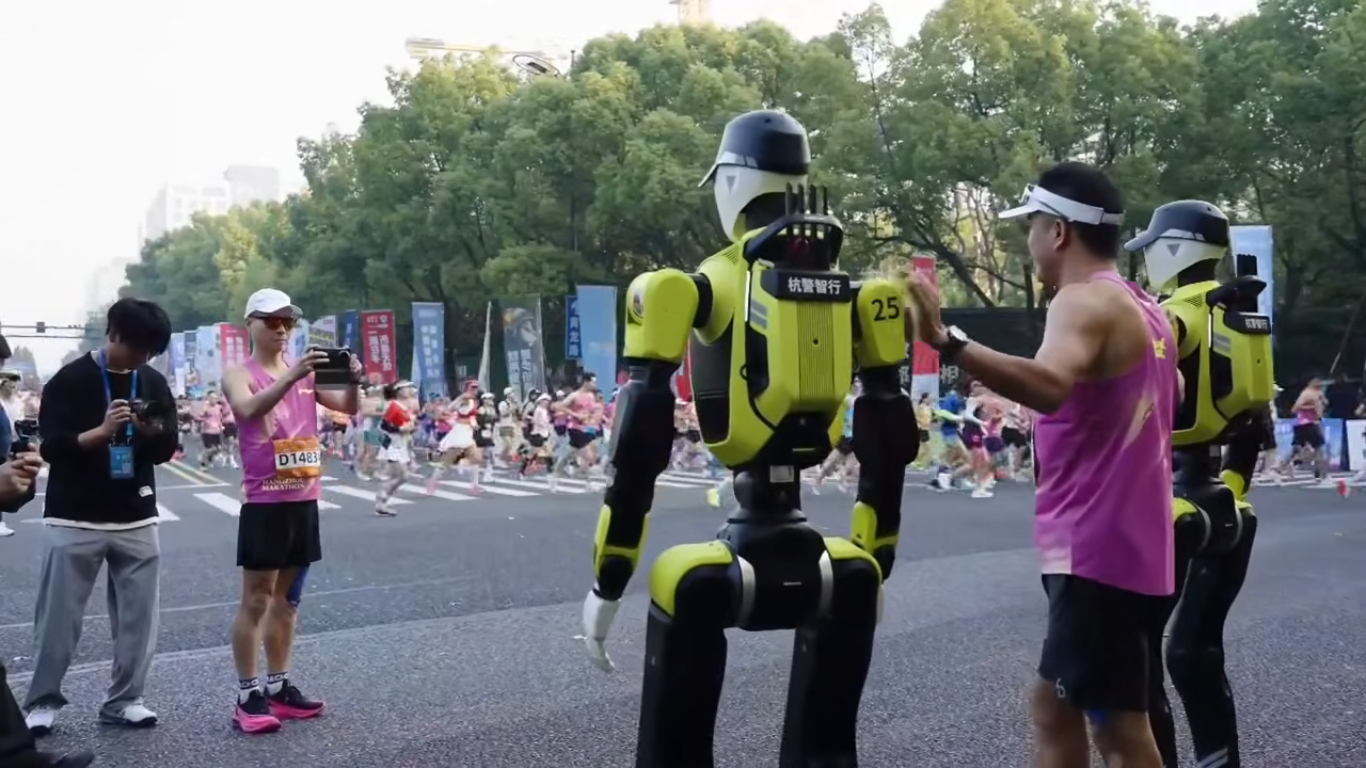


China has begun deploying humanoid robots to serve as police officers on the streets. But are these machines truly capable of recognizing emergencies, making decisions, and assisting people without human intervention? The footage released shows technology that is clearly evolving, yet it also reveals a significant gap between merely looking like a police officer and actually performing the duties of one.


This marks another step in the use of humanoid robots for tasks that were once the exclusive domain of humans. In this instance, the machines appeared on the streets of Hangzhou, dressed as traffic police—guiding pedestrians, monitoring intersections, and assisting security personnel during a major event. This was far more than just a simple technological demonstration.


On November 1st, these humanoid robots took part in traffic management for the Hangzhou Marathon, which drew approximately 36,000 human runners. Known as "Xiao Hang," the robots were developed by the Chinese firm Deep Robotics in collaboration with local authorities. Standing about 1.78 meters tall, they utilize the DR02 robotic platform, designed specifically for outdoor environments. But what exactly are these robots capable of doing?


During the event, the humanoids were stationed at strategic points near the Zhejiang Sports Center. Equipped with cameras and laser sensors, they can identify obstacles, track the movement of people and vehicles, and navigate along pre-defined paths. According to their developers, they are also capable of identifying certain traffic violations, issuing audible warnings, and performing gestures similar to those used by human police officers to direct traffic. Furthermore, they can answer questions from pedestrians, providing information about directions and nearby services.


There is another interesting detail: these robots were designed to withstand conditions that typically hinder the operation of humanoid machines. The DR02 features protection against dust and water, along with a structure engineered to function in various weather conditions—a crucial capability, as operating on a busy street requires far more than just the ability to walk.


The robot must be able to identify people who appear unexpectedly, dodge obstacles, and adapt its movements to a constantly changing environment. Prior to the marathon, the company had already conducted tests on the streets of Hangzhou, including operations during rainy weather and at events with large crowds. However, there is a significant limitation: these machines cannot yet replace human police officers. They perform specific tasks, while complex decision-making, emergency response, and enforcement actions remain the responsibility of the authorities.


Although they are already being used for various activities, there is no evidence that they can carry out all these tasks without human supervision, relying solely on their integrated AI. The goal is to determine to what extent humanoid robots can take on repetitive tasks, allowing human officers to focus on more critical incidents.


This experiment could mark the beginning of a broader shift. If the tests prove that these machines are safe and reliable, similar robots might eventually appear in airports, transit stations, public events, and other crowded spaces. For now, the police robots in Hangzhou remain part of a controlled experiment; yet, the fact that they are already working alongside human officers on busy streets demonstrates how robotics is beginning to move beyond the confines of the laboratory and into the fabric of daily urban life.


Sorry for my English, it's not my main language. The images were taken from the sources used or were created with artificial intelligence
