Starship entered Earth orbit for the first time.
in Popular STEM • 27 days ago

Starship entered Earth orbit for the first time.


Souce


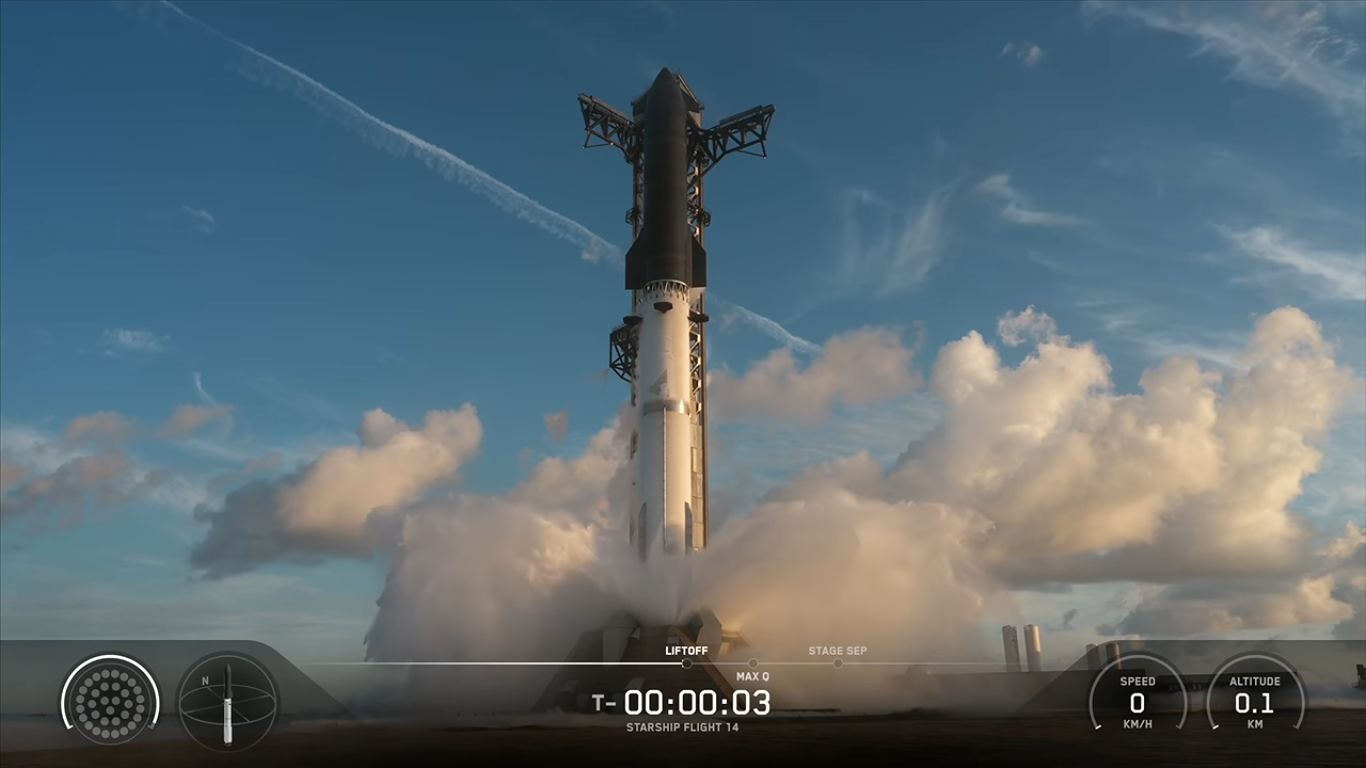
On September 28, Starship lifted off from the launch pad in Texas for its 14th flight, but this time there was a fundamental difference. In the previous 13 flights, SpaceX had deliberately kept Starship on suborbital trajectories—reaching space, conducting tests, and returning. This time, the goal was to take the step that transforms a massive experimental vehicle into something capable of truly transporting payloads into space: entering Earth's orbit.


For a few years, it seemed that might not happen. After separating from the massive Super Heavy booster, one of Starship's six Raptor engines shut down prematurely during the ascent; the other five kept running and partially compensated for the loss, but the issue raised a major question: would it be safe to put the craft into orbit knowing it would need to reignite an engine to return?


For several minutes, it appeared SpaceX might abandon the attempt to reach orbit and let Starship follow a suborbital trajectory once again. However, engineers continued analyzing the systems, and minutes later, a new decision was reached: there was sufficient redundancy for Starship to make the attempt. About 25 minutes after launch, one of Starship's engines reignited in space, and then something SpaceX had been pursuing for years finally happened.


Starship entered Earth's orbit for the first time. Yet, perhaps the most important detail is that it wasn't there merely to prove it could reach orbit; inside the craft were 26 actual Starlink V3 satellites. Starship had carried satellites of this type before, but on those occasions, they were on suborbital trajectories and ended up re-entering the atmosphere. This time was different; shortly after reaching orbit, Starship opened its cargo bay and began deploying them one by one. All 26 were successfully released, and SpaceX managed to establish contact with every one of them.


This transformed the mission into something unlike almost anything we had seen before with Starship; up to that point, each flight had essentially been a massive experiment. This time, while still a test, Starship was carrying out its first mission with an actual operational payload—and, according to Huters, its first revenue-generating mission. There is a reason these satellites are so significant: the new Starlink V3s are much larger and more capable than the previous generation. According to SpaceX, each one can add nearly 1 terabit per second of capacity to the network; the 26 satellites carried on this flight represent a combined capacity of approximately 26 terabits per second.


The company further states that a single mission with these satellites can add nearly ten times the capacity provided by a typical launch of Starlink Mini satellites using the Falcon 9; this is where we begin to understand how placing Starship into orbit transforms the entire project. The goal was never simply to build the largest possible rocket. SpaceX aims to create a massive, reusable vehicle capable of repeatedly transporting large amounts of cargo into space, and Starlink satellites could well be the first customers for this system.


Once Starship is fully operational, Elon Musk intends to place dozens of these new satellites into orbit with each launch, allowing SpaceX to expand its own constellation using a rocket it built in-house. However, the flight also demonstrated that the Starship A1 has reached the end of its development cycle. The mission was scheduled to last nearly 10 hours and complete approximately six orbits around Earth, but due to a propulsion system issue, SpaceX decided to cut it short to about 3 hours. Starship performed a de-orbit burn, re-entered the atmosphere, and concluded the flight with a controlled splashdown in the Pacific Ocean, north of Abai.


The Super Heavy booster also returned to the ocean but encountered issues during the descent engine sequence, resulting in a hard splashdown in the Gulf; thus, Flight 14 was both a milestone and a reminder of the magnitude of the remaining challenge. Starship finally proved it could reach orbit with a real payload, but it still needs to demonstrate repeatability, resolve propulsion issues, and—crucially—achieve one of the most difficult aspects of the original promise: returning and being rapidly reused.


This matters far beyond Starlink satellites; NASA intends to use a version of Starship as a lunar lander for the Artemis program. Before that happens, however, SpaceX must demonstrate far more complex space operations while the cause of the issue on this flight is investigated. There is a vast difference between where the program stood a few years ago and what occurred on this flight: for a long time, we watched Starships explode; later, we saw the vehicles reach space, watched Super Heavy return and get caught by the launch tower, and saw Starship perform re-entries and reach the ocean in a controlled manner. And now, for the first time, we saw a Starship enter orbit and deploy a real, operational payload.


This is precisely how some of Musk’s most ambitious projects tend to evolve: first, there is an idea that seems far-fetched; then come the prototypes, delays, and failures, until eventually, the system begins to function efficiently and consistently enough to become a viable business.


The images without reference were created with AI
Thank you for visiting my blog. If you like posts about #science, #planet, #politics, #rights #crypto, #traveling and discovering secrets and beauties of the #universe, feel free to Follow me as these are the topics I write about the most. Have a wonderful day and stay on this great platform :) :)


! The truth will set us free and science is the one that is closest to the truth!


Sort:  

Congratulations!

Your post has been selected and upvoted by the SteemPro Team 🚀

Explore more on SteemPro:
🌐 https://www.steempro.com
🎮 Play SteemHeights: https://www.steempro.com/games/steem-heights
💬 Join our Discord: https://discord.gg/Bsf98vMg6U

💪 Supporting the growth of the Steem ecosystem together.

🟩 Vote for witness faisalamin:
https://steemitwallet.com/~witnesses
https://www.steempro.com/witnesses#faisalamin

steempro-cover-black.png
This is an automated message.

Space X is a dream that has become an idea that has become reality. I find it truly fascinating to observe the technological progress made by SpaceX in recent years. What initially seemed like an almost unachievable project is gradually becoming a concrete reality. Personally, I consider the development of Starship particularly important, not only for the future of space missions, but also for the potential technological implications for terrestrial industry. The ability to recover and reuse rockets could help significantly reduce the cost of access to space. Of course, numerous challenges remain to be overcome, especially for lunar missions. However, I believe that SpaceX represents an interesting example of how research, investment, and perseverance can transform extremely ambitious ideas into concrete innovations. Thanks for this update post.