Critical scale effect
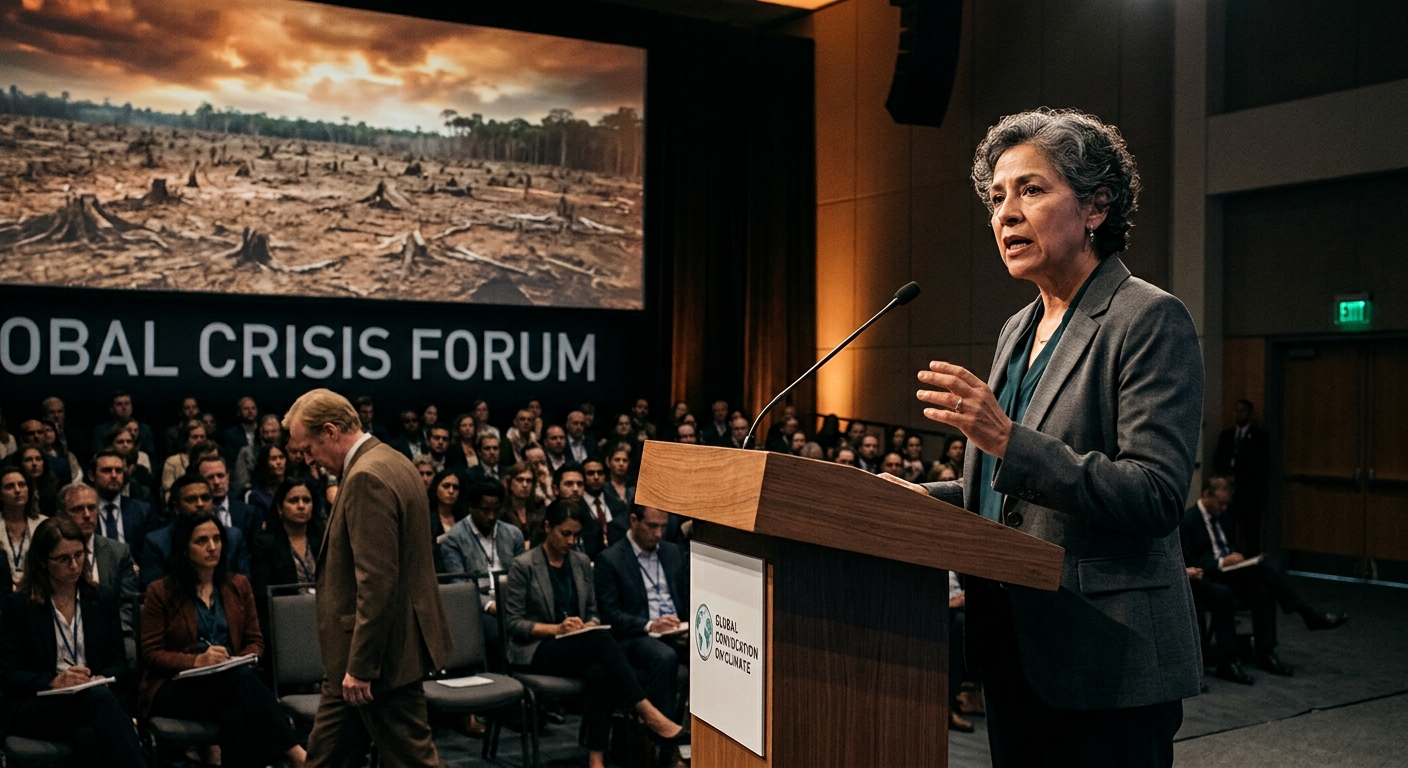
“Dr. Meza, how are you preparing for your speech on the climate crisis? We are all eager to hear the solutions you have to share,” asked Dr. Cooper.
“I am certain that the speech you are so keen to hear will come as quite a surprise, colleague,” Dr. Meza replied.
“I certainly hope so; many of us have pinned our hopes on you. If anyone has a solution to the problem, we are confident that it is you, Doctor,” Dr. Cooper stated.
“Forgive me, colleague. Perhaps we should meet later to talk. For now, there are still a few details I need to finalize,” Dr. Meza said, cutting the conversation short.
As soon as she stood before the podium and looked out at the audience, she saw an auditorium packed with attendees—colleagues, politicians, executives, and many others—all eager to hear what she had to say. She let out a brief sigh. “I hate to disappoint them,” she thought, before clearing her throat and beginning the speech everyone was waiting to hear:
“And to think that this disaster began many years ago? It was always within our power to stop it, mitigate it, or perhaps even steer it in a different direction.”
“The planet continues to die with each passing day; the damage is now irreversible. Our numbers are dwindling, and I know that when the final moment arrives, there will be none of us left.”
“The most intelligent species on the planet? Yes, that is what we are—yet, at the same time, we are also the most harmful and destructive species ever to have inhabited it.”
“The efforts made by the scientific community, NGOs, international organizations, and various civic coalitions proved insufficient in the face of the collective obliviousness of those who truly should have cared about this apocalyptic, critically-scaled outcome: us—the inhabitants of this planet.”
“Heatwaves were merely the first of many symptoms that ordinary people began to notice—and yet, they continued to prune or cut down the very trees that offered some resistance to climate change. And all for what? For quick fixes to everyday issues, such as fallen leaves, branches near power lines, or the construction of new infrastructure. Even an absurd aesthetic or commercial priority played a role: the visibility of some foolish sign should never have been placed above the environmental benefits provided by the trees that were sacrificed.”
“There are many tangible consequences that stem from the destruction of forest cover; but, ultimately, I believe many of you would agree with me that—far beyond the severe soil degradation and erosion or the disruption of the water cycle—the most significant factor is the massive release of carbon dioxide. Because the trees are gone, they are no longer able to absorb this carbon dioxide through photosynthesis—a fact that has only served to accelerate the global warming that has, today, brought about our destruction.”
“The felling of trees in urban environments simply destroyed the natural shade that kept local temperatures in check. On a macro level, the destruction of native forests was, for the planet, the equivalent of a person smoking unfiltered cigarettes: developing cancer was simply inevitable.”
No one in the auditorium dared to whisper, let alone leave the room; instead, silence took hold of the atmosphere. Everyone remained hopeful that Dr. Meza might yet say something to keep their aspirations alive—everyone, that is, except for Dr. Cooper, who quietly left the premises, visibly disappointed.
“The catastrophic and apocalyptic scenarios in which we live today are the direct consequence of altering the systems that sustained life on this planet. Deaths resulting from heart and respiratory failure are also a consequence of extreme heat.
The Amazon—once a vast tropical rainforest, a cradle for countless species, and the ‘lungs’ of the world—has become a dry savanna where only the hardiest species survive. Soon, it will turn into a barren desert, devoid of life; frankly, I hope I am not alive to see it.”
“High temperatures have also triggered the collapse of marine life; many species could not survive the rising water temperatures. In the Arctic, the thawing of permafrost is releasing immense quantities of methane and carbon dioxide into the atmosphere… In short, I regret to be the one to confirm that we are doomed to extinction. Any potential restart of life on this planet—if such a new beginning is even possible—will not include the human species.”
Story written in Latin American Spanish, my native language. Translated for Dream Steem using Google Translate.
Royalty-free cover image, generated with Gemini.
Cc: @weisser-rabe, @ladyaryastark and @ty-ty.
I understand why Meza felt so tired and hopeless. When you warn people and nothing changes, it's normal to feel like giving up.
But I believe it's not over for us. As long as people care, plant, speak up and try, there is hope. The future may not be perfect, but it can be better than this.
0.00 SBD,
12.27 STEEM,
12.27 SP
Waiting isn’t the same as taking action, my friend. Many have waited for things that never arrive. For now, I can tell you that the heatwave—here where I live—feels infernal; and yet, I’ve seen stupid people cutting down trees for no good reason at all, which is quite infuriating.
0.00 SBD,
0.01 STEEM,
0.01 SP
Thank you
That’s the point: it’s not that the planet is dying. It’s just becoming uninhabitable for us humans. Can we stop this from happening? I don’t know. Should we even try?
The problem, my dear friend, is that there is always something we could do—yet, incredibly, most people consistently do the exact opposite. For instance, they complain about extreme heat, but then they cut down or prune trees during the summer—a completely illogical act. I have seen trees cut down—trees that were already growing back in the days of someone’s grandfather, long before the person who ordered their removal was even born. And so, I have to wonder: if we all know what is happening, why do we keep doing the very things that are causing it? Of course, this is looking at it on a micro level. On a macro scale, it’s a different story entirely: the owners of large industries are only interested in production and the continued accumulation of wealth.
0.00 SBD,
18.87 STEEM,
18.87 SP
This is a hot topic – and I’ll go so far as to predict that it will remain so until the end of our days. As long as economic interests take precedence without any regard for conscience – and by that I don’t mean small business owners with big ideas, but global conglomerates – both people and the planet are nothing more than a resource.
What you say is very true. For many years, we have had information about the problems damaging the planet and their primary causes. But what good has it done? The deterioration continues, and, worse still, it is becoming increasingly severe. Frankly, I believe that if we are indeed headed toward such a drastic rise in temperatures in the near future, this home we call Earth will simply become uninhabitable for us.
0.00 SBD,
12.63 STEEM,
12.63 SP
Que bueno utilizar la ficción como herramienta para tocar esos temas sensibles de los que nadie hablar y que paradójicamente son de los que siempre deberíamos hablar!
I wish I could believe this to be fiction - and not forecast...
I wish this were merely fiction, but it is something that is becoming increasingly pronounced. Every path has a beginning, and the one we are currently on is already well underway.
0.00 SBD,
0.20 STEEM,
0.20 SP
Do you know why no one wants to talk about it? The truth is, we all know what’s happening, and we could all do something—even if it’s just a tiny bit, it’s still something; after all, even a glass fills up drop by drop. But do we actually do it? Very few people try, and they soon give up—simply because the rest don’t care, and, as you well know, anyone who doesn’t act like everyone else ends up being seen as a misfit.
Es cierto, porque al final, nosotros como consumidores podemos marcar tendencias, y aliviar en lo posible los daños al ambiente. La gente no mide el impacto que causa un ahorro individual a lo largo de un año o de una vida. Incluso llevar tu propia botella recargable de agua ayudaría a bajar la venta de botellas descartables, en cuya mayoría terminan en ríos y océanos cuando no están matando fauna silvestre...pero es más cómodo comprar y desechar. Y así con decenas de acciones cotidianas que hacemos por comodidad aunque al final solo colaboramos con el problema.
0.00 SBD,
18.17 STEEM,
18.17 SP
Thanks.
Many greetings from the Kitchen Gods!
We all listened attentive to this story, especially Vivienne who goes conform with Dr. Meza.
Wolf just said 'that's it' and took a deep draught from his cigarette.
I only murmured: 'Wish this were fiction.'
A very characteristic reaction from Wolf... I wonder if there is actually anything that could worry him or keep him up at night? It would also be very interesting to know his stance on this matter. Vivienne, if you understand that this is something that does not affect everyone equally—because, in the end, there will be no distinction between rich and poor—then you must realize that, unfortunately, in this instance, fiction is not very far removed from a future reality.
0.00 SBD,
0.20 STEEM,
0.20 SP
Wolf as an artist is very familiar with failing. That's why he is able to recognise whether an issue is over. The climate change issue is over - in the meaning, that we will have to cope with it without stopping it.
Vivienne does believe there will be a great distinction between the rich and the poor. The very rich will rescue theirselves to the remaining habitable zones, she expects.
I think mankind still could do something. Not stopping climate change but withdrawing from low level coastal areas and the like. Since this involves the rebuilt of large towns, Vivienne may be right in regard of Ghetto zones.
0.00 SBD,
18.08 STEEM,
18.08 SP